
Jordan Gigout
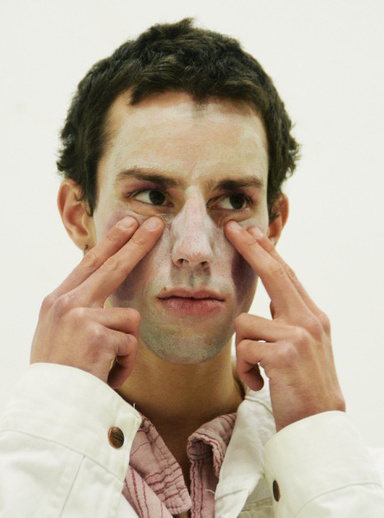
Jordan Gigout is a French dancer and dance notator working at the intersection of performance, writing, and speculative practices. Based in Germany, he has collaborated with institutions such as Tanztheater Wuppertal Pina Bausch, Staatstheater Kassel, and Folkwang Tanzstudio, and performed with choreographers including Céline Bellut, Carla Jordão, Marie-Lena Kaiser and Johannes Wieland. Since 2015, he has been a core member of FAKERS CLUB, a live cinema public performance experiment directed by Stephanie Miracle.
An alumnus of the German National Academic Foundation, Gigout earned his BA in Dance from Folkwang University of the Arts and is currently pursuing a Master’s in Dance Notation and Choreography Writing at the Conservatoire National Supérieur de Musique et de Danse de Paris, where he specializes in Kinetography Laban. His research repositions dance notation as a creative and ethical act—one that not only preserves choreography but shapes how movement is remembered, shared, and imagined.
During his Obermann International Fellowship, Gigout will offer workshops on dance notation and German Modern Dance for students in the University of Iowa’s Department of Dance, collaborate with Assistant Professor Stephanie Miracle on score-making methods for FAKERS CLUB, and engage with Iowa City’s literary community. He writes, “Notation is often seen as a tool of preservation, but I see it as a site of invention—a way to tell stories, challenge hierarchies, and imagine new futures for choreography. Through writing, we don’t just record dance—we reshape how it lives on.”
Shazia Rehman Khan
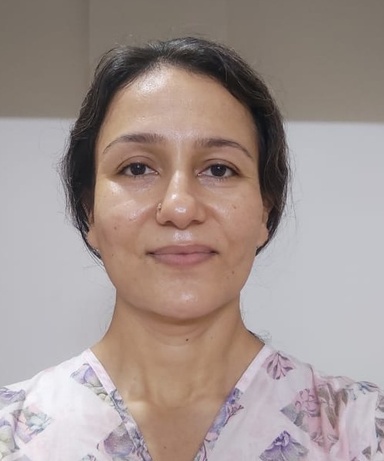
Shazia Rehman Khan (Rashid) is an Assistant Professor at Bahria University, Pakistan. She teaches Business Ethics and Critical Thinking at Bahria Business School and has a deep interest in human morality. Her research work looks at ethical decision-making within the context of organization.
While at the Obermann Center, she aims to deepen her understanding of the value of time, the way it is structured, and how it is distributed in work and other social contexts. Her work on time is founded in care ethics and justice theories, and through this she wants to develop a blueprint for time justice for the worlds to come.
Patricia Marga

Patricia Marga is a PhD student in public administration and a research assistant at the Department of Public Health at Babeș‑Bolyai University. Her work combines interdisciplinary research along with participatory approaches, having a strong focus on applied public health. Since 2022, she has been part of the iCreate project (Increasing Capacity for Injury Research in Eastern Europe), where she works with registries from Armenia, Georgia, and Republic of Moldova, analyzing different topics such as, unintentional injuries, traumatic brain injury, road traffic accidents and workplace violence. Starting September 2024, she is part of Create.Act.Enjoy, an NGO that produces and coordinates cultural, educational and art therapy projects, hand in hand with the community. The socio-cultural projects provide people in hospitals, nursing homes and children in orphanages with recreational activities performed by professionals from different domains, who are part of a one-year learning program, professional artists and volunteers.
Patricia is currently leading a citizen science project in Cluj-Napoca (supported by a Citizen Science Fellowship) in which citizens can contribute to mapping road safety risks using an interactive map on PARTIMAP, and cyclists can participate in recording street data for its assessment with the CycleRAP tool. This initiative bridges community engagement with injury prevention, advancing participatory research models in urban planning.
During her Obermann International Fellowship, Patricia will explore how academic institutions can support community-based public health research. She is particularly interested in the University of Iowa’s Bicycling & Pedestrian Simulator Research and its potential to inform safer and more inclusive urban policies in Romania. Her goal is to identify transdisciplinary models that translate community knowledge into evidence-based interventions for public safety and sustainable mobility.
Patricia's fellowship is co-sponsored by the UI Center for Social Science Innovation.
Pervin Saket
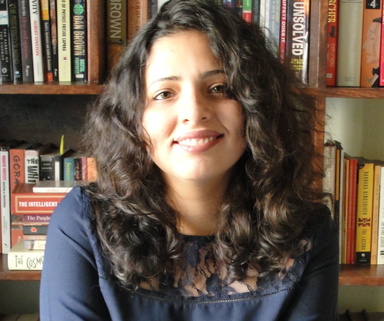
Pervin Saket is a poet, novelist, editor, and curator. Her work focuses on the intersection of gender, language, and community. She has served as the Poetry Editor of The Bombay Literary Magazine and the curator of Literature at the Kala Ghoda Arts Festival in India.
Her books include the novel Urmila, a feminist reimagining of the Ramayana in contemporary India; the poetry collection A Tinge of Turmeric; and a series of 10 landmark biographies-in-verse for children. In 2024, Saket was a writer-in-residence at the University of Iowa's International Writing Program. She has been awarded or a finalist for the Srinivas Rayaprol Poetry Prize, the Tiferet Poetry Prize, the Aesthetica Creative Writing Award, the Wheelbarrow Books Poetry Prize, and the Gaudy Boy Poetry Prize. Her work has been supported by the Vancouver Manuscript Intensive Fellowship.
During her Obermann International Fellowship, Saket will collaborate to create an artists’ book on the Zoroastrian community which is on the verge of extinction. The book will draw from historical archives and oral narratives to examine what it means for the world’s oldest monotheistic religion to teeter on the edge of disappearance. What burdens of culture and progeny lie specifically on women? How are these negotiated? And finally, what does it mean to hold on to tradition over transformation—and at what cost?