In a nation confronting one of the highest rates of traffic accidents in Europe, the simple act of crossing the street is a critical public health challenge. This issue is the driving force behind the work of Patricia Marga, a PhD student in public health at Babeș‑Bolyai University in Romania. She's on a mission to tackle this crisis by exploring how virtual reality can be harnessed to study and improve pedestrian safety for the most vulnerable: elderly citizens crossing busy city streets and children navigating crowded school zones. Her pursuit of research methods on injury prevention brought her to the University of Iowa this fall as an Obermann International Fellow.

“My research is focused on injury surveillance, and a big part of my job involves road traffic accidents,” she explains. “I came here specifically for the Hank Lab. I wanted to see how they use virtual reality in their research so I can try to build a similar, accessible lab back home.” Her goal is to create VR environments to study and improve pedestrian safety for two high-risk groups in Romania: children and elderly people.
During her three-week stay, Patricia immersed herself in the work of the University's Hank Lab, a nationally recognized center in the Department of Psychological and Brain Sciences co-directed by Drs. Jodie Plumert and Joseph Kearney that studies pedestrian and bicycle safety. A major highlight was observing a study on parent-child road-crossing behaviors that used both VR headsets and the university’s CAVE, an advanced, room-sized virtual environment in MacLean Hall. “The parent-child pair went into the CAVE, where everything is projected on the walls around you, so it feels real,” she says. “They had to decide when to cross a street with virtual cars passing by. It was very interesting to observe.”

Marga's time in Iowa was made possible through a network of collaborators. She worked closely with the Center for Social Science Innovation, where Dr. Ethan Rogers helped arrange her visit to the National Advanced Driving Simulator and her participation in the ArcGIS course. Dr. Cara Hamann, from the Department of Epidemiology, a connection from a previous NIH-funded project, provided crucial support by introducing her to faculty, courses, and overall academic life. These connections allowed her to attend university courses and meet with Drs. Plumert and Elizabeth O’Neal.
For Patricia, the fellowship's primary benefit was not simply observing the technology but gaining a comprehensive understanding of the operational framework required for sustainable research. “While the published papers provide all the details, I now fully comprehend the entire process and the team structure necessary to make it all work,” she explains. “Even when a grant provides the funds for initial equipment, sustaining the research activity long-term presents the real challenge.”
She realized that the key to the Hank Lab’s success is its interdisciplinary nature and its reliance on undergraduate student researchers—a model she now feels confident she can replicate. This collaborative approach was a crucial insight for her.
“It was very important for me to see how the labs here function,” she notes. “You have a group of people from different backgrounds with varied expertise, and together they make the project work.” She observed how a project could bring together a student from the informatics department to program the VR environment, another from psychology to analyze behavioral data, and others from various fields, each contributing their specific expertise. This model contrasts with the more compartmentalized nature of academic departments at her home university in Romania. She now has a clear path forward: “I'm going home with the confidence and clarity needed to launch this project. I can now communicate the mission effectively to recruit the right people for the team.”
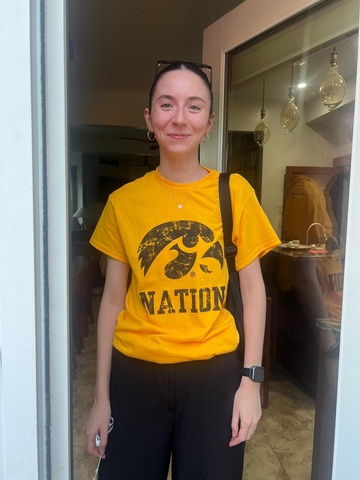
Beyond the lab, her fellowship was a period of unexpected personal discovery. She was struck by the quality of education and the wealth of opportunities available to students at the University of Iowa. “Coming to Iowa City, seeing everyone doing their thing in a city built for and with students—it’s different from back home.” She also experienced the local culture firsthand, from the safety and warmth of the city to staying with an American couple who ended up spending a great deal of time with her. “I really enjoyed my time here. It was above my expectations,” she says. “It was really nice to actually be part of the culture that I had seen in movies.”
She encourages anyone considering an Obermann International Fellowship to go for it: “It’s a great experience. You can find endless information online, but there is no substitute for the richer perspective you gain from actually experiencing something firsthand. You get to be part of the community with all the events that are happening in the city.”