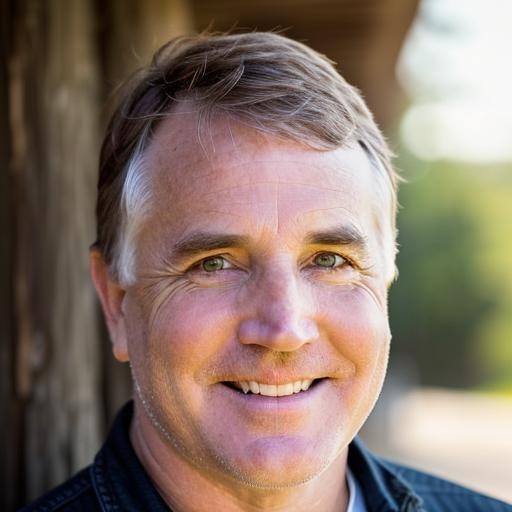
As part of the 2025–2026 Obermann Symposium, Cultivating Rurality: Building Community around Rural Research (March 26–27), we’re excited to welcome Andy Mink, founding director of the Smithsonian’s Rural Initiative. In his keynote “More than ‘Not Urban’: Serving Rural Communities as Places and as People” on March 27, he'll explore how the Smithsonian is redefining itself as more than a destination in Washington, D.C., becoming a public service accessible to rural communities nationwide through collaborative, community-sourced partnerships that respond to local priorities and challenges.
In advance of his visit, Obermann Program Coordinator Maria Torres Melgares spoke with Andy about his work and the ideas he’ll bring to the symposium.
What do you hope the participants who attend your talk will walk away with?
AM: I hope participants leave with a clearer understanding that rural America exists on a spectrum. While there are objective definitions of rural—based on population, distance, land use, or census metrics—rural as an identity is not binary. Some communities are remote towns of fewer than 100 people, while others are micropolitan cities that feel oversized relative to their surroundings.
In my work at the Smithsonian, we’ve learned that “rural” is not always a term people embrace as an identity. It’s rarely an either/or designation. The Smithsonian, as a 180-year-old institution with 21 museums, the National Zoo, and multiple research centers, is always thinking about identity and community, and the Rural Initiative asks how rural communities understand themselves and relate to those outside their environment.
In my talk, I hope to address “rural” as geography, place, and perspective—both place and person. I want to explore how rural contexts evolve, sometimes very quickly, and how rural communities are represented, since identity is shaped both by self-presentation and by how others see you.
How did your experience teaching in a public middle school in rural Virginia shape how you see rural communities in general?
AM: I grew up in rural coastal Virginia, lived in rural central Virginia for 25 years, taught there for ten of those years, and raised my children there. So, my perspective comes from being rural as a young person, a teacher, and a parent. Across all those periods, the central challenge of rural life is imagination—especially for young people. It’s about understanding what’s beyond the horizon and what opportunities exist. Rural spaces can feel insulated, and young people often struggle to see possibilities beyond their immediate environment.
What’s important is that opportunity doesn’t require leaving or abandoning a rural identity. It’s not an “either/or.” You can live a rural life and still access global networks and opportunities. As a teacher, I saw students who were curious and hungry to understand what was possible, but who sometimes felt cut off.
Even today, when I work with rural schools, I often encounter skepticism or a lack of confidence from students, about whether they belong in places like the Smithsonian; Washington, D.C.; or major universities. There’s sometimes a form of belonging insecurity that we work hard to overcome.
How well do you think technology can connect rural communities to cultural resources, and where does it fall short?
AM: Technology allows rural communities not just to access culture, but to contribute to it—to showcase their stories, perspectives, and identities. It enables communities to connect with one another, share local narratives, and build civic pride.
Technology affects everything from how young people learn, to how cultural organizations tell their stories, to how small towns participate in national moments like America 250. In many ways, technology has become the backbone that allows rural communities to engage culturally beyond their geographic boundaries.
What are the biggest barriers that prevent rural communities from accessing large cultural institutions like the Smithsonian, and what has worked best to overcome those challenges?
AM: The Smithsonian Rural Initiative was created to address this question directly. Distance is the most obvious barrier—if you don’t live near Washington, D.C., it’s hard to access our museums and programs.
There’s also a perception that the Smithsonian isn’t accessible or meant for everyone. Over the past several years, including through the Rural Initiative, we’ve worked to reposition the Smithsonian not just as a destination, but as a public service that can be accessed anywhere. By working directly in communities—through humble, collaborative partnerships—we can amplify local voices. The Smithsonian becomes a magnifying glass for local stories rather than the center of the narrative. Our goal is to reduce barriers by being locally accessible.
The key to this work is relationships: individual advocates who can welcome us into communities and help open doors for meaningful dialogue.
Looking ahead, what big opportunities or challenges do you see for rural communities? Can cultural projects help communities stay strong through those changes?
AM: Our work is grounded in national research across all 50 states, focused on understanding how rural communities see themselves, their values, and their priorities. The challenges rural communities face are often amplified by limited resources.
Climate disasters, population shifts due to remote work, and demographic change can dramatically affect small communities. Climate change, in particular, has major implications for land-based and agricultural professions. At the same time, these challenges create opportunities. Communities like Dubuque, Iowa, and Bennington, Vermont, are using arts and cultural projects to integrate new residents, tell inclusive community stories, and emphasize shared values rather than differences.
Rural communities tend to see themselves as resilient, loyal, and accountable. This isn’t mythology—there are real challenges—but there’s a strong identity around figuring things out and responding to change with what’s available. That self-identity is crucial when navigating large-scale transitions.
As someone with a background in both teaching and public history, what advice would you give to young rural teachers or artists who want to help strengthen cultural identity in their communities?
AM: Many rural communities are increasingly using art and culture as a measure of community health. Communities that can tell inclusive stories, celebrate identity over time, and make people feel they belong tend to be healthier, more civically engaged, and less isolated.
Cultural health attracts professionals—teachers, doctors, and others essential to community life. These dynamics reinforce one another. Young teachers, whether they’re from the community or not, are more likely to stay if a town feels welcoming, compelling, and alive.
For young educators or artists, rural communities offer an opportunity to make a meaningful, visible impact. Especially at a stage of life when you’re seeking connection, purpose, and community, contributing to a rural place can be both personally and professionally powerful.
__
Directed by Brian R. Farrell, Daria Fisher Page, and Ryan T. Sakoda, Cultivating Rurality: Building Community around Rural Research will take place on March 26 and 27, 2026, on the UI campus and in downtown Iowa City. The symposium will bring together scholars, community leaders from across the U.S., and professionals who work with rural populations and in rural spaces. Attendees will be invited to collaborate in theorizing rurality, share how it impacts their work, examine how rurality is represented and celebrated, and begin to discuss challenges faced by rural communities.
Andy Mink's keynote lecture will take place on Friday, March 27, from 3:00–4:00 p.m. in Room A at the Iowa City Public Library. It is free and open to the public.