
Imagine a small boat on large, dark sea. Imagine families of refugees, with small children and smaller bundles of belongings. Imagine them braving storms and starvation and shipwreck. It sounds like something from yesterday’s news report, but this historical exodus took place between the 8th and 11th centuries CE, when Arab Muslims conquered the once-expansive Persian Zoroastrian empire. Faced with religious persecution, groups of Zoroastrians escaped in boats and landed on the shores of Gujarat in India.
Pervin Saket’s project as an Obermann International Fellow focuses on this community, her community, in modern-day India. Zoroastrianism, the world’s oldest monotheistic religion, is now practiced by only a handful of people, and that too is threatened by extinction. Saket says, “In the version I learned on my grandmother’s lap, the Parsis (literally “people of Pars or Persia”) were taken to the local king when they washed up on the shores of Gujarat. Suspicious of the foreigners, he showed them a bowl of milk filled to the brim, to indicate his land was full. The Parsi leader responded by sprinkling a few grains of sugar on the milk. I suspect that the king had a fondness for good metaphors. He was sufficiently impressed to grant them asylum, but he laid down a condition: they would not marry outside the faith or convert his populace to their faith. My ancestors readily agreed—after all, they knew the pain of religious zeal.”
Today, however, there are only a few thousand Parsis left, and their commitment to that vow is likely to lead to their extinction. Pervin Saket’s book is therefore a creative and archival response to this moment in history. As a Fall '25 Obermann International Fellow, she is creating a collaborative artists' book that brings together material aspects of the community—clothes, food, artifacts, crafts, and personal objects—and converts them into textured paper. The text of the book combines poetry, history, and memory, and specifically asks what it means to be a woman at this turning point, since the pressures on women to marry within the faith and have (more) children are greater.
For Pervin, a poet, novelist, curator, and poetry editor for The Bombay Literary Magazine, the main highlight of the fellowship was the “gift of an expanse of uninterrupted time.” Back home, she is engaged in several different projects, and she appreciated the nurturing environment at Iowa that allowed her to engage in deep work on the book. This focused time was enriched by a serendipitous discovery: an exhibit at the Main Library on Paper Engineering in Art, Science, and Education. “This dovetailed brilliantly with the direction of the artists' book,” she says, “since so much of it is about paper conveying meaning and movement—through folds, through textures, through layering.” The exhibit, along with the extensive examples in the library’s Special Collections, took her work in new and unexpected directions.
A key practical benefit of the fellowship was being in the same time zone as her primary collaborator, Kimberly Maher, who was formerly associated with the IWP and the UI Center for the Book. This proximity allowed for a much smoother creative process than working across several oceans at inconvenient hours.
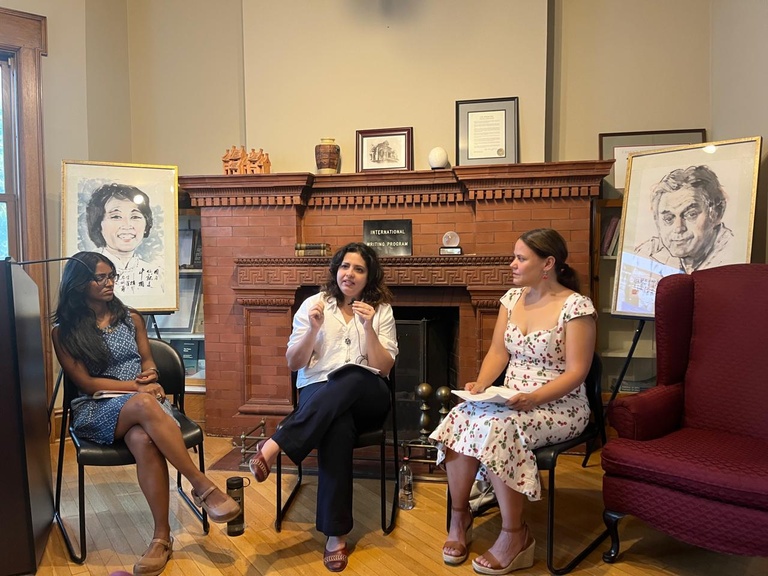
During her stay, Pervin reconnected with and built new relationships across the university. Having been a resident at the International Writing Program (IWP) last year, she returned to Shambaugh House for a special panel discussion on her work. Called "Text and Textures: Women Creating Books with Bite," this panel included artist Diane Vadino, was moderated by Devanshi Khetarpal, and explored how hybrid work can represent critique and disruption. Pervin also met with faculty from the English Department, including Loren Glass and Zara Chowdhary, to discuss future collaborations. These possibilities include featuring her work in a course syllabus and a book discussion around her poetry collection A Theory of Knots, which will be released next year by Seagull Books and University of Chicago Press. In her role as an editor, she also invited Kendall Heitzman, a UI professor of Japanese and Translation, to guest-curate a special edition of The Bombay Literary Magazine.

When asked what she would say to someone considering an Obermann International Fellowship, Saket reflects on the importance of perspective. She quotes the scholar Edward Said: “The more one is able to leave one's cultural home, the more easily is one able to judge it, and the whole world as well, with the spiritual detachment and generosity necessary for true vision.”
“This has been my experience,” Pervin adds, “allowing me to witness what was once very intimate with the distance needed for insight, craft, and honesty.”