Spacer
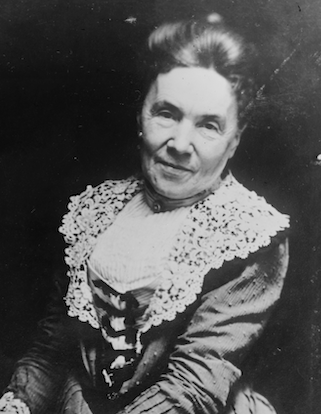
Laura Spelman Rockefeller (1839–1915) was raised in the Midwest, living a short time in Burlington, Iowa before her family moved to Ohio. Her father Harvey Buel Spelman was a member of the state legislature (it's unclear whether in Ohio or Iowa) and an abolitionist who was part of the Underground Railroad. As a young woman, she was a school teacher at the Hudson Street School in Cleveland, Ohio where she was promoted to assistant principal at the age of 22.
She met John D. Rockefeller, then a bookkeeper, in an accounting class, and they married in 1864. John would go on to found the Standard Oil Company and become one of the wealthiest Americans of all time. As an adult, Laura was a well-known philanthropist, supporting many causes, including child development, education, public health, race relations, religion, and social welfare. In her will, she asked that other than a $450,000 bequest to family all of her wealth, $1,500,000, should be distributed by her executors to charities and educational institutions including what was then the Spelman Seminary and today's Spelman College, a leading HBCU. In 1918, her husband established the Laura Spelman Rockefeller Memorial in her memory. [Read more]
The foundation focused on building infrastructure for research and training in "child studies" with an emphasis on interdisciplinary research. by creating child studies institutes at a half dozen universities, including the Universities of Iowa and Minnesota, the University of California-Berkeley, the University of Toronto, and Yale and Columbia Universities. In 1928 the Foundation was merged with the Rockefeller Foundation.
At the UI, the funds were awarded in 1929 and accepted in a letter from President Jessup. In 1932, they were dedicated to the Iowa Child Welfare Research Station (ICWRS) by the Regents. Decades later, when the ICWRS closed, the funds were transferred to the Obermann Center.
Support for artists, scholars, & researchers focused on the well-being & education of children & families
In the spirit of Laura Spelman Rockefeller's commitments and the focus of the Foundation that honored her, the Obermann Center uses Spelman Rockefeller funds to support artists, scholars, and researchers whose work focuses on the well-being and education of children and families. We are currently using these funds to support Obermann Working Groups, Small Important Projects, and Interdisciplinary Research Grant teams whose projects fit these funding priorities.

Apply for Funding
Special funding is available for Obermann Interdisciplinary Research Grant (IDRG) projects in the areas of children’s learning and development, child welfare, and maternal education through the Laura Spelman-Rockefeller Grant. To apply for these funds, please use our Interdisciplinary Research Grant application.
Obermann Working Groups and Small Important Project Grant recipients doing research in these areas will automatically receive Spelman-Rockefeller funding.
Obermann scholars supported by Spelman Rockefeller funding (2025–26):

Leveraging Fruit Fly Genetics and Clinical Genetic Testing to Help Identify Genes Associated with Intellectual Disability
This project seeks to leverage the expertise of a board-certified clinical and molecular genetic pathologist-scientist with extensive patient DNA analysis, who will mine largescale patient databases of individuals with intellectual disability (ID) in order to discover previously unidentified ID genes. The approach will move beyond gene discovery in research-only cohorts and connect candidate gene selection to real-world clinical testing data from a large, diverse pediatric patient population. The project will also leverage the expertise of a geneticist with over 25 years of experience using fruit fly models of human disease to functionally validate the newly identified genes. Once the fly homologs of the human genes are identified, the team will utilize a gene-silencing approach to “knock down” the identified genes in the brains of the fruit fly, followed by high-throughput analysis to assess whether these “gene knockouts” result in clinical features consistent with those of ID. This proposal will lead to concrete outcomes (i.e., better diagnostic yields) that ultimately translate scientific discovery into better guidance and support for patients and their caregivers.
Co-directors: John Manak (Biology, CLAS, UI) and Benjamin Darbro (Pediatrics, Carver College of Medicine, UI)
Unbound: Learning without Limits
This group supports faculty, staff, students, and other interested individuals in investigating how learning, instruction, and learner and educator support is facilitated in informal learning environments such as maker spaces, wilderness areas, museums, libraries, community centers, and out-of-school-time youth clubs and organizations. The group is a reading and discussion group whose efforts will focus on better understanding and applying research on learning in informal environments to members' own individual work.
Co-directors: Kathy Schuh (College of Education) and Kay Ramey (College of Education)

Small Important Projects Grants
The following 2025–26 SIP recipients were granted Spelman funding:
- Megan Ronnenberg (School of Social Work, CLAS): Spelman funds supported focus group participation among childcare providers, which provided insight into how economic hardship is experienced in their daily work, how providers navigate financial tradeoffs, and how structural conditions shape providers' well-being and workforce stability.
- Hae Sun Kim (School of Music, CLAS): Spelman funds provided honoraria for ten experts to review the Foundation for Hearing and Speech Resources Music Therapy Assessment tool for deaf and hard-of-hearing children ages 4–9.
- Kimberly McFadden (Iowa Reading Research Center): Spelman funds purchased data analysis software licenses for researchers coding/double coding transcripts of interviews with 30 special education teachers who provide reading instruction to Grades 6–12 students with word reading difficulty.