Upcoming Events & Deadlines

Application Deadline: Small Important Project Grants promotional image

Application Deadline: Small Important Project Grants

Thursday, April 1, 2027 5:00pm
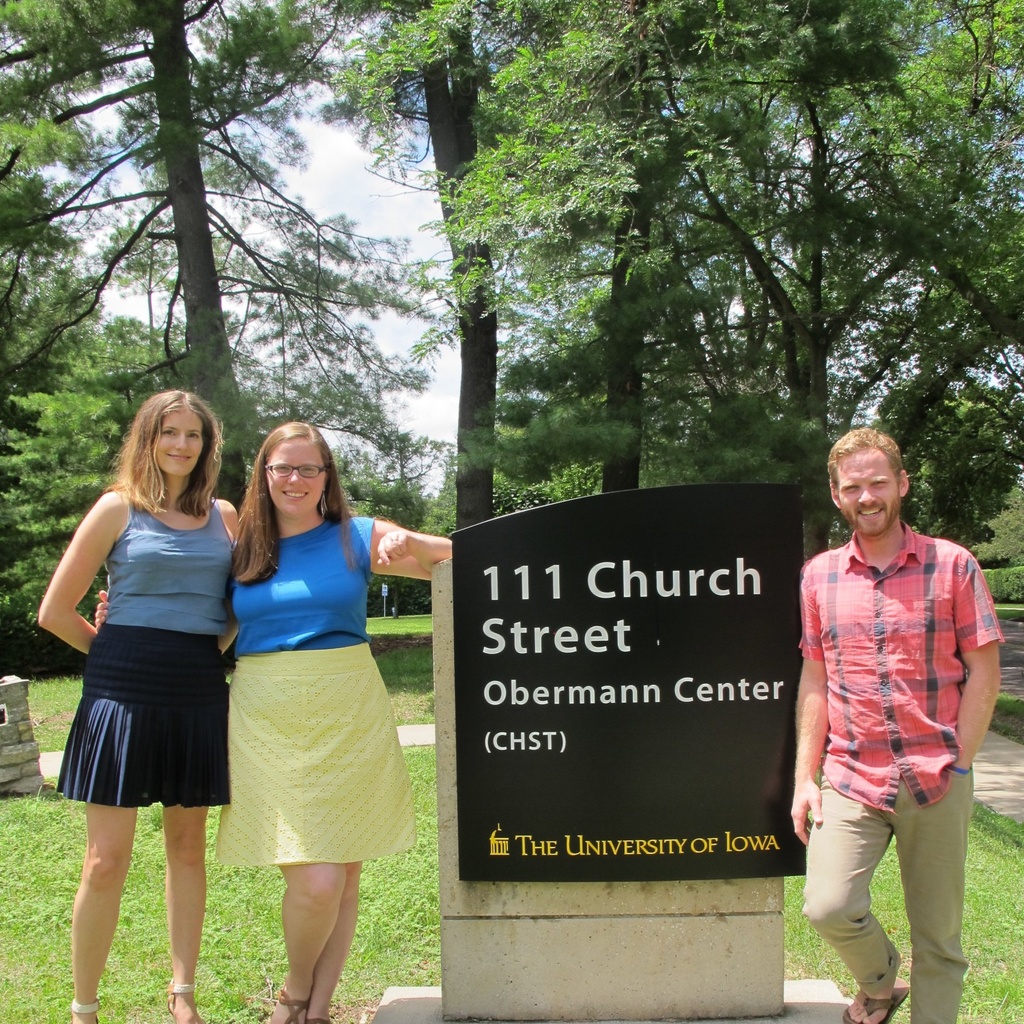
111 Church Street

This new Obermann Center program offers modest yet swift support for those portions of research and creative endeavors by UI scholars that are important toward advancing a project but do not have enough funding from other sources. We will grant 10 awards of $500 or less per academic year. Note that funds need to be spent by June 30 of each year.

Eligibility: Open to all University of Iowa faculty and staff researchers who have not received a SIP award in the past academic year.

Application...

Application Deadline: Obermann Working Groups (2027–30) promotional image

Application Deadline: Obermann Working Groups (2027–30)

Wednesday, April 7, 2027 5:00pm
111 Church Street

Obermann Center Working Groups provide space, structure, and discretionary funding for groups led by faculty that may include advanced graduate students, staff members, and community members with a shared intellectual interest.

Groups have used this opportunity to share their work in progress or draw up a set of readings they want to undertake and discuss. Others have organized conferences, applied for grants together, written articles together, designed new courses, taken field trips, organized...

View more events

Spacer

News

Have No Fear - Exhibit explores the role of Middle Eastern artists post 9/11

9/11 Unleashed Ethical Questions Like many current students, Rachel Winter (MA candidate, Religious Studies) vividly remembers 9/11 as a pivotal moment of her early childhood. The day was already set to be a serious one as her mother was scheduled to undergo a critical surgery at a hospital near downtown Chicago. As events unfolded on the east coast, it was unclear if other cities might be...

Apply for Summer '17 Alternative Careers for Humanities PhD Candidates Workshop in Chicago
Angela Toscano (English) and Anu Thapa (Cinematic Arts) were selected as Humanities Without Walls Fellows for last summer's workshop. The program is part of an Andrew W. Mellon Foundation award to the Illinois Program for Research in the Humanities (IPRH) at the University of Illinois at Urbana–Champaign to fund an extensive consortium of fifteen humanities institutes in the Midwest and beyond...
IDRG group stands outside of Obermann Center

The Meek and the Mighty: Interdisciplinary Research Grant Explores Diversity Programs

The “Big Ten Conference” is often used as shorthand for football. But faced with demands for a more just society, this group of Midwestern research universities has also taken the lead in making higher education accessible. In 1968, at the height of the Civil Rights Movement, Indiana University led the Big Ten in establishing a program for first-generation college students. A decade later, in 1979, during the Women’s Movement, Ohio State University was the first in the Big Ten to create a living-learning community to support and recruit women in STEM fields. Since then, Big Ten schools, like most universities in the United States, have implemented programs that provide community, mentorship, and other forms of support to minority and culturally diverse students. What factors influence the time to adoption of these programs? What impact do the programs have shortly after they’re adopted? Does, for instance, the percentage of women majoring in STEM fields increase on campuses that implement those support programs? Do students who participate in such programs tend to stay enrolled at the school and finish their degrees, compared to students who don’t? These are the questions Aislinn Conrad-Hiebner (School of Social Work, CLAS),  Martin Kivlighan (College of Education), and Elizabeth Menninga (Political Science, CLAS) are exploring as part of their fledgling project “The Meek and the Mighty: Exploring Diversity Programs among Big Ten Universities,” which they initiated last summer as part of an Obermann Interdisciplinary Research Grant.

Meet the Manuscript with Obermann Graduate Fellow Heather Wacha

28 beaver fur hats. 6 panels of tapestries. Wool from Flanders. Silks, cloths, and linens. Furniture, paintings, and sculptures. Gold and Silver. All manner of carriages. If you had been an heir of the estate of Don Francisco Muñoz Carillo, a nobleman from Cuenca, Spain, who died in 1687, you may have received some part of these items. However, before you get too excited, you would have also...

2015-16 Obermann Annual Report

Welcome to the 2015-16 Obermann Center Annual Report! View the report in its entirety. I often find the best inspiration for the year ahead is a quick look in the rearview mirror. That’s certainly true for the Obermann Center, where that mirror frames a panorama of fellow travelers—faculty, staff, students, and partners—in 2015–16. In Summer 2015, faculty with Obermann Interdisciplinary...

Humanities research and the human condition

This article by Obermann Center Director Teresa Mangum appeared in the July 14, 2016, edition of Iowa Now: If you follow news about higher education, you know that the value of humanities scholarship—the study of the arts, cultures, history, languages, literature, philosophy, and religion—is often called into question. Pummeled by busyness, technical challenges, health care costs...

Recent Events

Fall Institute on Teaching with Writing: Session 1 promotional image

Fall Institute on Teaching with Writing: Session 1

Friday, October 1, 2021 2:00pm to 5:00pm
Virtual

Creating Meaningful Writing Tasks: Breaking Assignments into Smaller Parts

How do we design meaningful formal writing assignments that engage and motivate our students?  How do we use smaller writing-to-learn tasks that scaffold and prepare them for those formal assignments as well as inform us instructors how they are learning what we are teaching?  How do we build multimodal elements into assignments to expand meaning-making opportunities? 

This workshop will focus on designing and...

What Is Critical Race Theory?: Perspectives from Business, Law, & Sociology promotional image

What Is Critical Race Theory?: Perspectives from Business, Law, & Sociology

Thursday, September 30, 2021 7:00pm
Virtual

On July 1, 2021, Iowa House File 802 became law. Though the Act does not specifically mention “Critical Race Theory,” CRT was cited in discussions of the Act, and the Act restricts when and where the framework’s historical, social, and legal tools for understanding race-based inequities may be taught. But what is critical race theory, and how has it become the focus of acts and editorials? On Thursday, September 30, at 7:00 p.m. CST, a legal scholar, a sociologist, and a community advocate for...

Seeing Asian American Life through the Video Essay promotional image

Seeing Asian American Life through the Video Essay

Thursday, September 23, 2021 7:00pm to 8:30pm
Virtual

Join us for a virtual panel and screening with video essayist Kevin B. Lee, whose work both demonstrates how one can use the arts, literature, theory, and history to offer an understanding of human experience—in this case, of Korean Americans and other ethnic groups—and illustrates a relatively new form of research, the video essay.

We will screen Lee's video essays, including Mourning with Minari and Once Upon a Screen: Explosive Paradox (see descriptions below). Afterward, Lee will join...

Trans Health & Medical Care: Where We Are, Where We Came From: A (Virtual) Obermann Conversation promotional image

Trans Health & Medical Care: Where We Are, Where We Came From: A (Virtual) Obermann Conversation

Wednesday, September 22, 2021 7:00pm to 8:00pm
Virtual

Surfacing in the mid-twentieth century, yet shrouded in social stigma, transgender medicine is now a rapidly growing medical field. UI alumna and Michigan State University professor stef shuster shares findings from their new book, Trans Medicine (NYU Press, 2021) in discussion with Dr. Katie Imborek, co-founder of UIHC's LGBTQ Clinic, and community archivist and PhD candidate Aiden Bettine, whose work creates and demands gender-affirming community spaces.

Protests, Military Coup, and Burma's Future promotional image

Protests, Military Coup, and Burma's Future

Wednesday, September 22, 2021 12:00pm to 1:00pm
Virtual

Featuring Maxime Boutry, Associate Researcher, Center for Southeast Asian Studies, National Center for Scientific Research (CNRS), Paris, France

The double crisis, political and sanitary, that Myanmar is currently undergoing, sheds new light on the political and social transformations that have affected the country over the last ten years. Whilst the February 1st military coup literally kidnapped the hopes of a whole generation of citizens thirsting for democracy, it also revealed a failed...

What Do We Mean by Humanities Research Now? — An Obermann roundtable promotional image

What Do We Mean by Humanities Research Now? — An Obermann roundtable

Friday, September 17, 2021 12:00pm to 1:00pm
Virtual

Across the country, humanities centers act as incubators for cutting edge questions, creative collaborations, publicly engaged projects, and experimental forms of humanities scholarship. To kick off our conversation about the challenges new forms of research pose to existing metrics, we’ve gathered directors of four humanities centers. Join us as they offer their perspectives on emerging humanities research questions, methods, and formats, and the challenges these pose to current metrics...