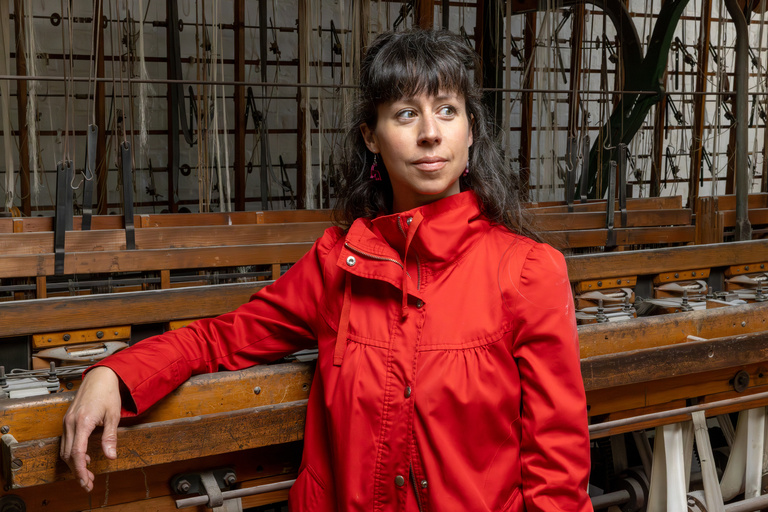
Stephanie Miracle’s ensemble is large. Mechanical engineers, musicians, hydroscientists, robots, zoological specimens, filmmakers, parking ramps, at least one professor of 18th-century literature, and the Iowa River all have found a place in collaborations honored this year by the Obermann Center for Advanced Studies.
Miracle is the inaugural recipient of the Obermann Interdisciplinary Achievement Award, a peer-nominated prize for University of Iowa faculty who excel in collaborative work, fostering new dialogues across fields. In addition to her teaching, Miracle is a performer, choreographer, and the artistic director of FAKERS CLUB, an international live-cinema project.
At Iowa, Miracle’s intellectual challenge to her peers has built a thriving community. For artists, scholars, and scientists alike, her projects demand the use of underworked mental muscles, ones that risk atrophy in disciplinary isolation. “One of the biggest challenges is making time to listen to all the voices involved,” says Miracle. These voices are inner ones, too. By hearing out the creatives, the realists, and the problem solvers in ourselves and others, we can build more resilient, more productive, and more nourishing connections.
Walking together in the new home of the UI Department of Dance, I ask Miracle about the responsibilities and rewards of interdisciplinary work. Around us, students rehearse in rooms that were once galleries; light enters through the same east-facing windows the river entered in 2008. One of these windows illuminates Miracle’s new office. Its view includes the banks and bridges where, in 2025, Miracle and her collaborators staged Meandering River, an interdisciplinary performance about the mutual influence of Iowans and Iowa’s waterways. Water, like people and institutions, has a complex memory of routes, obstacles, gathering places, and points of contact. I sat with Miracle for an hour. In the time it took to chart the flow of careers, performances, and creative relationships, the light from the river had reached our knees.
***
How did you find your literal and figurative dance partners? What was it like to bring them to your field?
People who are open to collaboration have a spark and curiosity. With Deema Totah [assistant professor of mechanical engineering], it was that way. It would be easy to see us as vastly apart from one another, but engineering demands a lot of creativity. I just cold-called her. Not being so precious about things can really build momentum and freedom.
You both said yes, in a broad sense.
Yes! We both said yes.
Collaborating on Meandering River was the same. I think David Cwiertny [professor of civil and environmental engineering] said, well, we’ve tried all other avenues. There’s got to be something we can do with the arts. Why not lean in and see what it can yield? The whole group met that comment with genuine interest.
I can see why your colleagues speak highly of you. It’s exciting, the prospect of drawing new intellectual threads from one another after careers spent apart. Is there an inherent relationship between dance and interdisciplinarity?
Interdisciplinarity is important in general, but in dance, it’s a powerful tool. You mentioned threads—it’s a weaving process, making ways to other ways of thinking. I'm interested in how those connections linger after a performance.
What do you find remains after dancers and participants disperse?
New questions and experiences bubble up. We call each other; conversations continue over years.
I often think about longevity. I hope my students won’t see their bodies and careers as something that will crumble by 30, but something they can listen and adapt to.
A short career is one of the old narratives of dance, along with intense physical perfectionism. Do you ever find that rigidity surfacing in your interdisciplinary work?
I would love it to show up more, in some ways! I love the discipline of dance—“discipline” in the other sense. The dailiness, the practice. The compositional tools I learned in choreography are so transferable. I also love the non-linguistic part of it. The body-to-body transfer of knowledge, feeling something you know someone else is feeling, and doing it over and over again. It’s one of my favorite aspects of dance, that transfer without words.
What are the challenges of interdisciplinary work? What gets in the way?
Time is a big challenge. There are so many people involved. Like any democratic process, you have to budget time for listening. And for becoming comfortable with uncertainty; that often leads to important discoveries. But you have to be strategic about that, too, and not waste resources.
A breakdown of trust is fatal. Collaboration and interdisciplinarity are not the same thing, necessarily. Interdisciplinarity is a framework built on collaboration. Everyone has to be invested in something beyond themselves. It can’t be just one vision.
More information about Miracle's collaborations and choreography, including with UI engineers and the Meandering River project, can be found on her website. Miracle will present a new work of interdisciplinary choreography at the Obermann Center's October 13 Counterpoint event, "Holding Space: Stories of Interdisciplinary Collaboration." A panel discussion with Deemah Totah, Eric Gidal, and Miracle will follow. The event will take place at the Voxman Recital Hall at 5 p.m.; it's free and open to all.