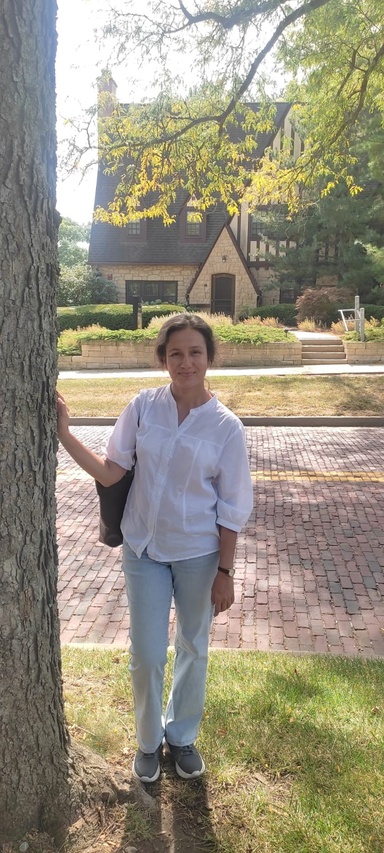
Often, an hourly employee, bound by the routines and schedules of a workplace, finds that she is constantly thinking about being somewhere she is needed more, perhaps at home, taking care of a child or elderly relative. While many researchers have studied how this internal conflict affects the worker's professional output, few have studied how it affects her self-image or moral self-concept. This is the province of Shazia Rehman Khan, Professor of Business and Social Ethics at Pakistan's Bahria University. Her scholarship asks whether women are the primary victims of organizational time structures (as they must often balance workplace schedules with demands for care and domestic work) and, more generally, how "clock time" shapes our moral selves. Khan recently spent a month at the University of Iowa as an Obermann International Fellow furthering her research on time justice and care ethics.
“The fellowship gave me a deeper understanding of how international research and teaching are structured,” Khan shared. “It also helped me see how some of these practices could be adapted to my own context.”
A highlight of her residency was presenting her research in Professor Asha Bhandary's Iowa Care Lab class, where undergraduates learn how to think critically about care and caregiving practices and to imagine and construct new caregiving arrangements. Khan's ideas sparked lively conversation among the students and helped her gain fresh perspectives on teaching approaches that emphasize dialogue and engagement.
“My work evolved through discussion,” she said. “The students’ questions led me to think in new ways, and Professor Bhandary helped me identify other scholars whose work connects with mine.”
She also participated in Obermann's Writing Collective, spending two hours per week writing alongside UI faculty and students; she devoted the time to updating and fleshing out her research plans.
Khan encourages other international scholars to embrace the Fellowship opportunity:
“A fellowship like this not only helps you shape your research and teaching—it gives you confidence in your work, which is key to moving forward.”