
“You have to dance,” says Nichole Nidey, an assistant professor of epidemiology in the College of Public Health. “That’s the best way to get a good print.”
Nidey is speaking to a young guest of the first-ever Pressing Matters exhibition, a girl of seven or eight. Laid on the floor of Close House, the downtown home of Public Space One, is a blank t-shirt and an inked linocut plate. Together, laughing, Nidey and her new young friend take turns to hop on the plate and dance their design into being. They eventually reveal a perfectly imperfect print of a work currently hanging in the next room, one of many that visitors to the show can replicate and take home.
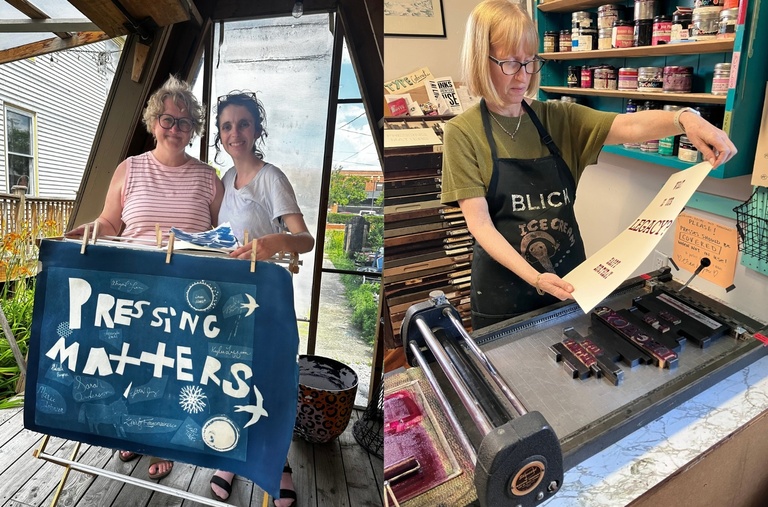
Nidey and her co-investigators Alison Lynch (Department of Psychiatry, Carver College of Medicine), Kalmia Strong (formerly of Public Space One), and Laura Moser (Public Space One) are the recipients of a 2026 Obermann Interdisciplinary Research Grant. The Pressing Matters exhibition is the culmination of two weeks of printmaking workshops organized with Obermann funds. Subtitled “Rolling Out Stigma,” Pressing Matters was designed to translate qualitative research findings on substance use disorder (SUD) by including the voices and expression of people actually living with the condition. The artworks in the exhibition are all made by people with personal connections to substance use.
Before we sit down, Nidey brings me to a small flock of sea-blue cyanotypes—prints made by solar exposure—slung in a broad, smiling arrangement from lengths of twine by clothespins. Workshop participants filled these artworks with symbols, patterns, shapes, and letters, and Nidey knows their meanings. She helps me see the children, the siblings, the parents, the regrets, the dreams, and the fears all fluttering together. The prints seem suddenly weighty, their airy suspension a profound impossibility. The women who made these artworks, Nidey tells me, live a highly stigmatized experience. Their full personhood is often erased. She explains that the purpose of Pressing Matters is to challenge that stigma by encouraging visitors to see humanity and addiction at the same time. The outcome is both better research and better public health messaging.

Pressing Matters is the latest extension of many years’ work for Nidey and Lynch. Nidey is an epidemiologist and founder of the EMPOWER project, a collaborative designed to improve outcomes for pregnant and postpartum people with SUD, while Lynch is the director of the Division of Addiction Medicine and founder of the Opioid Addiction Clinic in the Carver College of Medicine’s Department of Psychiatry. Between them, they have decades of knowledge and experience working with populations living with SUD.
After the tour of the galleries, I sat down with Nidey and Moser to discuss the scope and outcomes of the project. We finished just as the hum of visitors began to rise. I joined the growing crowd, where I observed a man scanning the linocut prints. He was a workshop participant, I knew; I recognized him from a photo Nidey had shown me. When he found what he was looking for—a print on the walls, black and white, showing a human figure with stars and initials cut in the sky above his head—I’m not sure he noticed the hand he lifted to feel the paper again.
***
RD: My first few questions are for you, Professor Nidey. You and Professor Lynch share some research interests, including maternal health and substance use disorder. But how did you two find each other, and how did you come from your first meeting to tonight’s Pressing Matters exhibition?
Nichole Nidey (NN): I met Alison when I came to Iowa for my faculty interview, so I’ve known her three years. I did do my PhD at Iowa, but I never met Alison while I was a student. The really fun thing about Alison, though, is that I met her a long time before I actually met her. I was looking back through my charts, because I delivered a baby here at University of Iowa Health Care. And the first doctor that visited me and my son after delivery was Alison. We were destined to be together!
Beyond that connection, I always seek out research partners who are in a clinical space. Without someone in medicine, you can't fully understand what's happening and can't design medical interventions. But Alison doesn’t necessarily have the research training and background to do the quantitative side.
So it’s a really mutually beneficial relationship. And we have such similar ideas. We care a lot about people who use drugs. We hate stigma. We want to do whatever we can to help people get the care they want. That’s why we work together so well.
RD: And at what point did Pressing Matters begin to take shape?
It was when the Obermann Center released the call for Interdisciplinary Research Grants! I saw it, and I'm like, this is so great! Finally, a grant that would work for our project! And I knew I wanted to do something with PS1, too, because it's my favorite place in the world. So because of you guys Pressing Matters was born.
RD: We’re very grateful to support your work. I wonder if you could talk a little about how Pressing Matters complements the epidemiological perspective on SUD. How does your field traditionally conceptualize SUD and its effects?
NN: In epidemiology, we care about numbers. We count how many people have substance use disorder, what characteristics are associated with it, and what things might help to reduce drug use. But my work is a little different.
I've always kept the human beings in view alongside the numbers. Ever since I was a postdoc, I've done community-based work with people who use drugs, and I train them how to be researchers themselves. A lot of the stories and experiences we heard in the Pressing Matters workshops are the kinds of thing that motivate my research questions, and I don’t think I could ask those questions if I didn’t spend time with people who use drugs.
RD: Do you find other researchers are inclined to see things the same way?
I think it's becoming more common than when I started. I founded a collaborative called the EMPOWER project, dedicated to improving health outcomes for people with SUD who are pregnant and postpartum. I couldn't find anything like it when I was finishing my PhD at Iowa. And in the research I was reading for my degree, I always hated how people who used drugs were talked about.
The language was so stigmatizing, and not really objective or scientific. In papers, I would find broad, sweeping generalizations about drug users that would conflict with or misrepresent the paper’s own citations. That’s just bad research! A part of me thought, you know, research quality would improve if we brought some actual, lived experience to the table.
So that was the first grant I wrote when I was a postdoc in Ohio, and that’s how I started working more closely with this population.
RD: What have treatment initiatives for SUD looked like in the past? In other words: what helps people living with SUD, and what doesn’t?
Putting people in a box does not help. You often see strong assertions like “this is the treatment we use for substance use disorder. Everybody has to follow this and do the same thing.” And of course that doesn't work, because everybody is different. Criminalization and punishment also don’t work. That’s something I wish we would get away from, society-wise. There are plenty of drugs in prisons. If the goal is to reduce a person’s drug use, prisons don’t appear to achieve that.
RD: You said you came to this research through a bias you identified in the literature. I suspect research involving mothers and infants is full of implied bias of all kinds.
So much! It’s interesting that with maternal health and substance use, some things also depend on where you live. In a few U.S. states, using drugs while pregnant is a felony or effectively punishable as one by other charges.
I worked as an expert witness in Ohio, and pregnant women who used drugs faced much higher prison sentences than other drug users because they were charged with supplying a pregnant person, i.e., themselves, with drugs. But you won’t ever see the men involved in the conception of those pregnancies serve that kind of time for drug use. So there are gender elements at play in how we punish substance use.
In Iowa, mothers who use substances during pregnancy are reported by mandate to Child Protective Services, and they’re put on a child abuse registry for ten years, regardless of the frequency of their drug use. If they stopped using drugs in their first or second trimester, they will still never be able to volunteer at their kid’s schools or participate in their lives the way other parents can. That includes fathers who may have used drugs. This kind of thing only produces alienation, and probably helps drive people toward substances, not toward treatment.
RD: Which misconceptions about SUD would you magically correct if you could?
NN: That people with SUD are using drugs or alcohol for pleasure. Usually, people with SUD will say something like “the only time I feel normal is when I'm using this substance.” It gets them through the day.
This gives a new perspective. Of course we should figure out how to take the drugs away. But doing that is harder if we don’t understand what it takes for users to feel functional and be functional. You can't just take the drug away and say “Yep, we're fine,” because then there’s a hole, and something’s missing. I think we generally focus on substances and not the reasons for substance use. But how people tell the story of their substance use is fascinating. It’s also important for epidemiology and for clinical intervention design.
RD: Other misconceptions? There are lots, I'm sure.
NN: That drug users are always inherently violent or dangerous. Or that a drug test is a parenting test, or the only parenting test that matters. Stigma makes it hard for people to accept, but plenty of terrible parents have never used drugs, and plenty of parents who do use drugs still take good care of their families. People often say “how could you use drugs while you have kids? You must not love them.” But drug users do not love their families or their children any less than non-drug users, or any less than people who rely on less stigmatized and criminalized substances.
There's one family I worked with in Cedar Rapids. Their house was much safer than mine with little kids. Every single outlet was covered by a safety plate, and there were baby gates everywhere. I commented on it. And they said we do it to keep our kids safe, and so that no one comes in here and thinks we don’t care. They know that as soon as they were classified as drug users, they lost part of their humanity, and someone could come and check up on them at any time. One thing, like not covering the outlets, could be enough to impact custody.
RD: My final few questions are for both of you. I know that art therapy has stronger links to some conditions than others. Have the Pressing Matters workshops revealed anything about the relationship of artmaking and SUD?
NN: Laura made an excellent point earlier about the cyanotype workshop. A participant had put something backwards on the paper during the solar exposure, and she was worried the print wouldn’t turn out. But it did. There was still time to put things right, and the result was worth it. It turned out different, but beautiful.
Laura Moser (LM): There are certainly ways that art and recovery reflect each other. In recovery, it’s common to focus on practice, not perfection, on showing up each day and being present. When you’re making art, you have to stay in the moment with the materials. I think printmaking lends itself especially well to these workshops.
RD: I can see that. Printmaking is process-oriented, but there is also room for redirection.
LM: Yes. There’s a lot of freedom and there are a lot of unknowns. Some parts are under your control, other parts are not, and you have to see what happens when you try your best without being too perfectionistic, anxious, or judgmental. You have to accept the things you can’t change.
RD: There's a little bit of accident involved in it, too.
LM: Absolutely! I think people are delighted when they surprise themselves and see something in their hands they didn’t expect or believe they could make. That’s probably the best part of recovery, too. Discovering the life you didn’t think was possible.
RD: Stigma subtracts humanity, but making art can add some of it back.
NN: You’ve made me think of one of the guys in the linocut workshop. He told me and Alison his mind is always, always, always racing. But when he’s cutting his design into the rubber plate, he has to focus, because you can cut yourself if you’re not careful. And he found it was a way to turn the noise off for a little while. The carving had a meditative effect. You have to be right there, fully.
RD: And it engages multiple senses.
LM: There’s a reason why you get immersed in that process, it can feel addictive. I didn’t expect to hear someone with a history of addiction say in my workshop “this is my new addiction,” but there’s a reason art feels good. There’s something about making art, especially for people who are in pain. It does transport, and it does make you extend yourself a little outside the box you get put in.
RD: Why does SUD need to be a public conversation? And how does PS1 see itself participating in that conversation?
LM: I think having the conversation at PS1 made a lot of sense. One of the things that makes PS1 so special is our community access print shop. It’s a wonderful resource both for members and for the public. And I think some of the experiences that have been most interesting and transformative for me have been with people who don’t necessarily see themselves as artists. They don’t feel recognized that way, even if they have creative interests. A great thing about Pressing Matters is that it makes the studio space available to people who didn’t know it was here, and wouldn’t necessarily have believed it was here for them, too.
RD: On the topic of the public: some groups are really hard to reach with traditional public health messaging.
NN: One hundred per cent.
RD: Who can Pressing Matters reach that traditional appendages of public health can't?
NN: I think if you say to people, “Hi, why don't you come and talk to me about your highly stigmatized substance use and how it interferes with your life,” it’s hard to bring anyone in. Art is a little like hiding the vegetables in the mac and cheese. It’s less hostile. Let’s just come and enjoy the mac and cheese together and see what happens.
In none of the groups did we say “let’s talk about your substance use.” But it came out in every workshop anyway. It was not forced. Participants started to build the connections with each other and that led to more openness among themselves. People don’t always want to talk about these things. But they will come to make art, they will come to share a meal. You suddenly find yourself in really important conversations with people who would have never come to the research table otherwise.
This is why Obermann’s interdisciplinary research grant is so perfect compared to a federal one. In a big federal grant, you have to lay all the variables out. It would have been prescriptive and rigid. I would have had to direct the conversation. Here, I could be a participant and learn without having to orchestrate.
RD: What other health conditions would you like to see acknowledged in public in initiatives like this?
NN: Mental health in general. Art and mental health belong together. But really any highly stigmatized condition. It’s a way we can show the world that our participants are people. We can also show what their experience looks like when it takes other forms than the usual narratives or data points.
RD: My last question: if the workshop and the people who organized it could say anything to people living with SUD or to their loved ones, what would it say?
LM: I felt a lot of love in the workshops. The reason why art is meaningful to me is that it connects people. What I hope people get out of it is that we can be together if we want to be, and no one has to be alone with whatever they’re going through.
NN: A quote that you often see in substance use-related talks is that “the opposite of addiction is connection.” These workshops tell participants that regardless of where they’ve been or what they’ve done, they can make something beautiful, and they will be welcomed, that they belong. I hope the participants felt like this was their workshop, not mine.
I think whatever magic sauce PS1 has needs to be applied to the addiction and recovery space more broadly. You get groups together you would never otherwise find in the same place, and they’re all connected, they all feel involved.
LM: If you love someone, you have to see them as a whole person.
RD: And that’s how we can neutralize stigma. Thank you so much for the invitation to the show today. I so appreciate it.
NN: It was a joy.
LM: Of course.