“I suppose what’s always speaking to me in the back of my mind is my mother,” says Benjamin Darbro. “She’s really the one who inspired this problem solving.”
My question to University of Iowa professors John Manak, of the Department of Biology (College of Liberal Arts and Sciences) and Darbro, of the Stead Family Department of Pediatrics (Carver College of Medicine), was about the nature of their work. What is your relationship to complexity?
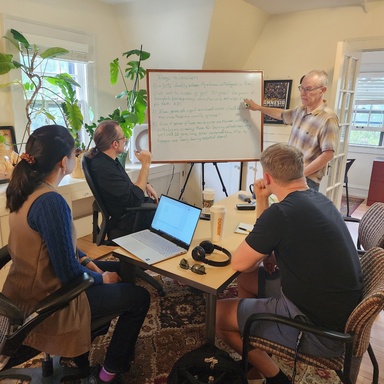
“There are some scientists who, I would argue, are less successful when they do cookie-cutter stuff,” says Manak. He and Darbro are recipients of a 2026 Interdisciplinary Research Grant from the Obermann Center for Advanced Studies. During a two-week residency at the Obermann House this past summer, they carried out novel genetic experiments in the study of intellectual disability (ID), a common neurological disorder characterized by communication difficulties and limitations in memory and learning.
In our conversation about their project and their Obermann residency, the complexity of relations between wholes and parts, effects and causes became a recurring theme. To me, this complexity was as apparent in the researchers as it was in the object of study. Creative scientific minds, it seems, are formed and enlivened by surprising links between disparate phenomena. In the hour we spent together, we touched upon just a few of them: mothers and mystery stories, samba and physics, The Beatles and pigs.
***
So, the first of the fundamental questions. How did both of you come to be researching intellectual disability, and how did you come to be working with each other? If that isn’t the same story.
BD: My clinical work is in molecular cytogenetics, the study of chromosomes and genetic disease. One thing our clinic does is testing on patients, typically pediatric patients, who are suspected of having genetic disorders. One of the most prevalent of these disorders is intellectual disability (ID). Our Obermann funding was an opportunity to work with John and some of our graduate students to really take this testing to the next level, and try to discover new genes that contribute to ID.
And how did you and John find each other? Were you already aware of each other's work?

BD: John and I go way back, maybe 15 years. We were some of the first individuals on campus to use microarrays to study DNA. We were part of this original group called CNV Iowa, and we were both very involved in the study of a kind of DNA mutation called a copy number variant, where a person has either more or fewer copies of a specific DNA segment.
I think that's when we became aware of each other's work. It started at the genomic level. We’ve worked together since then for several years. This new project is really an opportunity to leverage our expertise to do something neither of us could do alone. A great friendship came out of it.
JM: We’re kindred spirits, intellectually. We feed off of each other's energy. And like Ben was saying, we can do things together that we can't alone.
RD: In this case, expanding research into intellectual disability.
JM: Ben and I both have a real affinity for neurodevelopmental and neurological disorders. The main focus of my lab is epilepsy. But Ben has the bioinformatics skills to look through large clinical databases and identify potential genes associated with a particular disorder, and I was trained as a Drosophila geneticist. I study fruit flies.
RD: Yes, the flies—can you explain why you chose Drosophila for this project?
JM: At least 75%–85% of the genes that cause human disease are conserved in fruit flies, and they do the same things in flies that they do in humans.
So imagine Ben can take a big database of patient DNA and look for alterations in the genomes. And then imagine we can overlap those alterations with individuals who have been diagnosed with a particular disorder. So we’re looking across many, many people: Which patterns of DNA alteration seem to be responsible for that particular disorder? Once we have an idea of those patterns, we can test them in a fly by reducing the expression of the correlating genes in the fly’s brain and observing its behavior. Because we can screen hundreds of flies at a time to increase statistical power, and because we can perform the behavioral tests (such as learning and memory or social and communication abilities) relatively quickly, we can expand the number of genes tested far beyond what can be done in more complex animal models; 30 of those genes will be tested for association with ID for the first time.
What are some of the challenges of working with such large datasets? How do you even go about marshaling that much information?
BD: You’re right that they’re just too big to do manually. You have to use fairly sophisticated bioinformatics to really interrogate them.
In this case, we have a database of DNA from several thousand patients. We can see where they have missing pieces of DNA or duplicated pieces. And we use a technique called network-based stratification to see what variants all these patients share and what genes are affected by them. Then we try to see where the groups of genes that are involved with the same biological processes are disrupted. Then we look for where those disruptions match disruptions we know to be associated with certain diseases.
RD: The scope seems daunting. Very large haystacks, very small and complicated needles.
BD: I spend a good portion of my job saying, clinically, “I don’t know.” Our ability to interrogate the genome has far outstripped our ability to interpret it. I often like to say I could sequence anyone’s genome right now. It would cost a couple hundred bucks, and it would take a day or two. But I could essentially give you a book that’s got your entire genome sequence. You’d open that book up, and 98% of it would be in a foreign language. About 2% would be in English, but poorly constructed. You’d get a general sense, and that’s it. That’s where we are with clinical genomics right now.
Sometimes we find a DNA mutation we know causes disease. Other times—a good portion of the time—we look at a genomic test and we don’t see anything; it looks normal. But anywhere from 20% to 40% of the time, we find something unusual, a VUS.
JM: A “variant of uncertain significance.”
BD: And we have no idea if it’s causing a disease or if it’s the reason someone has curly hair. That’s the thing about copy number variants. A variant can involve thousands of base pairs and hit multiple genes, so it’s hard to know, when we find something new, exactly what it’s doing. This is a really big problem in clinical genetics, and that’s what we’re trying to work on by taking these VUSs and determining whether these genes might be involved in the phenotype we’re studying, in this case, intellectual disability.
RD: And how would you like to see this project advance?
JM: You said you overheard our excitement upstairs before the interview. I’m really, really confident we’re going to get some hits here. We have a strong confidence we will find some new genes associated with intellectual disability.
After the Obermann funding is finished, there’s a clear path forward. Our fantasy project is to take the genes we’ve validated in our flies and try to assess whether drug treatments could bring the altered brain gene expression patterns correlated with the intellectual disability of these flies to a more normal level.
RD: Variants of uncertain significance—it’s such an abstract phrase. It leads me to my next question. Both of you have built careers on rather difficult problems. What is your relationship to complexity?
BD: At the heart of it, we're problem solvers. And I think that in science, one of the best ways to have a long and fruitful career is to pick a difficult problem.
JM: A long and fruit-fly career! Yes, it’s about picking a difficult problem. And when it comes to genetics, there's absolutely no shortage of these very difficult problems. Likewise when you're talking about neurodevelopmental conditions—not just intellectual disability, but also developmental delays, autism spectrum disorder, and I would include epilepsy in there as well. These are very complex. One of the things we're recognizing is that the underlying genetic basis for a lot of these conditions is shared. It's not always about one gene, one disease.
RD: And where else does complexity surface for you, John?
JM: For me, I'm a British detective series junkie.
RD: Oh, excellent.
JM: I love Inspector George Gently. I've been bingeing. Have you seen any of those?
RD: Yes! Though not for a long time.
JM: Oh, they're terrific. Nothing speaks better to why I do science, and why I do the type of science I do. I love complex problems that involve a lot of nuance, that allow you to express creative powers. I'm a big proponent of connectivity between the so-called left brain and right brain. I think that's critical to being a good scientist. I've been a musician all my life. The left brain and the right brain are constantly talking, and they’re equally important.
You need the smarts, but you also need the intellect to ask the right questions. Oftentimes the answer you get is not the one you expect. There are some scientists who, I would argue, are less successful when they do cookie-cutter stuff. There isn't a whole lot of creativity in that type of science.
RD: The struggle between the data and the brain’s ability to conceptualize it is both the challenge and the joy, it sounds like. Are there any other researchers whose creativity you find inspiring, or aligned with your own?
BD: I've always enjoyed coming up with new applications for existing techniques. We didn't actually create network-based stratification, for example. It was developed by Matan Hofree at Stanford, I think, and he used it in cancer research, so for us to use it for germline disease is sort of a novel approach. The same thing with non-negative matrix factorization. We didn’t create that. It’s actually used frequently for things like facial reconstruction. These techniques were designed to solve different problems, but they’re robust enough we can use them in a new way.
JM: Can I go back to the musicianship stuff?
RD: Of course.
JM: We can talk the same way about music. We could talk about any discipline. Anybody who rises to the top and creates something different, who isn’t just treading water. The Beatles come to mind. Their songs can be so sophisticated for a pop group, their harmonies so intricate. It speaks to what Ben was talking about, using techniques from other applications and making them new and surprising.
RD: Disciplinary boundaries can be hindrances. And it seems like researchers in genetics, like the two of you, are more than willing to cross those boundaries. Where does that willingness live in your minds? Are there works or figures outside of “hard science” that have exerted an influence over your intellectual lives?
BD: I suppose what's always speaking to me in the back of my mind is my mother. She was an elementary school teacher and principal, and she valued education very highly. She was always supportive and encouraging, and she instilled in me a real desire to learn and do well in school. She’s really the one who inspired this problem solving, and I always felt the most interesting problems were in science. I like complex problems.
JM: A few neurons are firing in my brain. There’s a great book called “Surely You’re Joking, Mr. Feynman!”: Adventures of a Curious Character. Richard Feynman was a very famous physicist, and the book is autobiographical. I love that book because you realize Feynman has this really interesting creative side. If I remember correctly, he went to Brazil at one point to learn to play drums in a samba band, and apparently, he got really, really good at it. What always stays with me are the characteristics of individuals who achieve exceptional things.
RD: One last question: both of you began your careers in biology. Do you have a favorite life form? One you still find marvelous?
BD: I would have to say humans. The thing about humans is the degree of complexity. It’s just astronomical. Nature has had millions of years to come up with some pretty complicated systems, and despite all that we do know, the sheer amount we don’t is humbling.
JM: For me, it’s really easy. Pigs. People have this negative conception of pigs, and it’s the furthest thing from the truth. They are sentient beings—they’re as smart as a three- or four-year-old child, and the way we treat them sometimes is horrendous. I’m considered the pig guy at Iowa Farm Sanctuary. Every Sunday, I’m there, and we open up the sanctuary for what we call strolls, and I give visitors information about the pigs. I’ve spent hundreds of hours with them. I’ve learned so much from the intelligence of these animals.
RD: Thank you both, again, for your time today. I’m looking forward to the outcomes of your study.
BD: Of course.
JM: Thank you!