Upcoming Events & Deadlines

Application Deadline: Small Important Project Grants promotional image

Application Deadline: Small Important Project Grants

Thursday, April 1, 2027 5:00pm
111 Church Street

This new Obermann Center program offers modest yet swift support for those portions of research and creative endeavors by UI scholars that are important toward advancing a project but do not have enough funding from other sources. We will grant 10 awards of $500 or less per academic year. Note that funds need to be spent by June 30 of each year.

Eligibility: Open to all University of Iowa faculty and staff researchers who have not received a SIP award in the past academic year.

Application...

Application Deadline: Obermann Working Groups (2027–30) promotional image

Application Deadline: Obermann Working Groups (2027–30)

Wednesday, April 7, 2027 5:00pm
111 Church Street

Obermann Center Working Groups provide space, structure, and discretionary funding for groups led by faculty that may include advanced graduate students, staff members, and community members with a shared intellectual interest.

Groups have used this opportunity to share their work in progress or draw up a set of readings they want to undertake and discuss. Others have organized conferences, applied for grants together, written articles together, designed new courses, taken field trips, organized...

View more events

Spacer

News

Street pickers with can carriers in Matanzas, Cuba

Yellow Fever's History of Humans, Microbes, and Ideas

Yellow fever was once a terrifying killer that violently took the lives of half of the people who contracted it. It killed workers building canals, soldiers engaged in sieges, and investors on fact-finding missions. A viral disease spread between humans and primates, it is caused by a species of mosquito that prefers clean, fresh water. Before this was proven decisively in 1901, yellow fever was a...

NHA Advocacy Day

Obermann Director Teresa Mangum joined hundreds of humanities faculty members, center directors, and leaders of professional organizations like the Modern Language Association and the American Historical Association in Washington, DC. As part of the annual NHA Advocacy Day, they shared the educational, social, and economic benefits of the arts and humanities. The NHA especially encourages...
Esco in his 20s wearing a suit and bowtie

An Aerial View—Remembering Esco Obermann
Esco Obermann embodied interdisciplinarity. That's him in the photo to the right, upside down on his parents' windmill in Yarmouth, Iowa. (Look closely—the soles of his shoes are aligned with the motor.) Esco, one of nine siblings, grew up doing acrobatics on his family's farm in southeastern Iowa—backbends on bulls, rope stunts in haylofts, L-sits on windmills—as if driven to seek new...
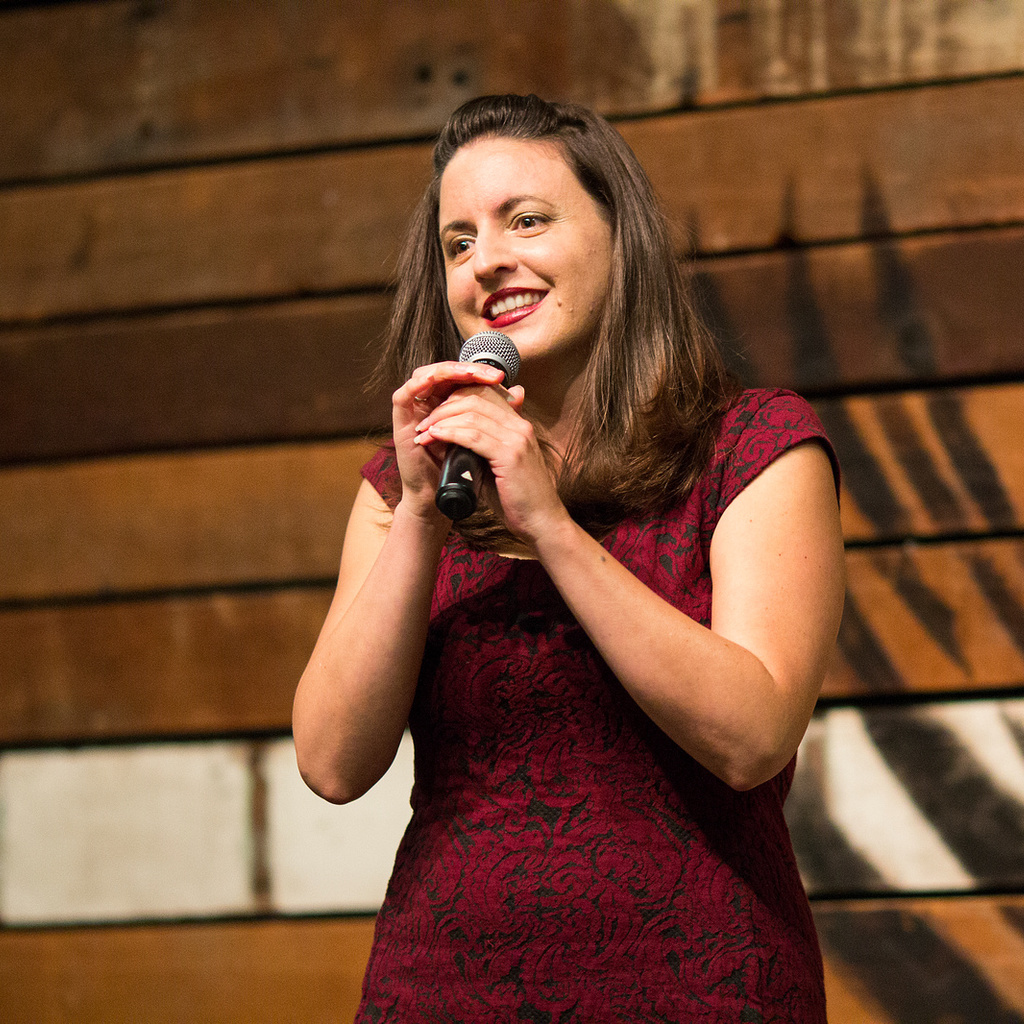
Nina G

Nina G: Stuttering comic walks the line between satire and issue advocacy
Bay Area comedian Nina G works tough territory. She plays gigs at clubs with names like “Nightlife on Mars” and “The Laugh Boat.” She stutters. And she’s really funny about it. While most stand-up comics engage their audiences through relatable stories, Nina G’s work pulls that kind observational humor into the broader intersection of comedy, satire and issue advocacy. That’s tough territory...
HPG_logo_0.png

Humanities for the Public Good Seeks Post-Doc, Research Assistant

While we tend to assume one attends graduate school in the humanities to become a professor, deep immersion in anthropology, art, history, literature, philosophy, and other cultural disciplines is excellent preparation for all kinds of workplaces--especially when content is enhanced by competencies sought by a variety of employers. In fall 2018, the University of Iowa received a four-year grant...

Save the date! March 8 Career Diversity in the Humanities Working Symposium

SAVE THE DATE! Career Diversity in the Humanities: An Obermann Humanities for the Public Good Working Symposium March 8 from 9–5 at the Iowa City Public Library Across the country, leaders of PhD programs in the humanities face a conundrum. How can a department honor the subjects, methods, and practices of their disciplines while also preparing graduates for diverse careers? To...

Recent Events

The Art & Science of Attention — An Obermann Conversation promotional image

The Art & Science of Attention — An Obermann Conversation

Wednesday, March 25, 2020 4:00pm to 5:00pm
Iowa City Public Library

NOTICE: This event has been postponed. We hope to reschedule soon. Please check back.

Please join us for this free, public Obermann Conversation about attention and focus. We are living in an age of distractibility. Understanding how our brains attend and focus, as well as what we can do to cultivate attention, is necessary for our effectiveness and happiness. 

Shaun Vecera's (Psychological and Brain Sciences) overarching work attempts to understand the basic yet complex mechanisms of...

Canceled
What Can Museums Become: "Future Media of Museums" promotional image

What Can Museums Become: "Future Media of Museums"

Saturday, March 7, 2020 2:00pm to 3:30pm
Art Building West

The 2020 Obermann Humanities Symposium, "What Can Museums Become?", will bring together a distinguished group of museum directors, curators, educators and artists who will reflect on the transformative work that museums perform in the twenty-first century.


The closing keynote lecture on Saturday will be delivered by Michelle Kuo, who is the Marlene Hess Curator of Painting and Sculpture at the Museum of Modern Art. In "Future Media of Museums," she will explore the evolving impact of...

What Can Museums Become? —2020 Obermann Humanities Symposium promotional image

What Can Museums Become? —2020 Obermann Humanities Symposium

Saturday, March 7 to Monday, March 9, 2020 (all day)

Museums have never been mere containers for objects, nor should they be. How might we draw strength from existing institutions to enable vibrant futures? How can we expand the communities who feel a sense of belonging within and around museums? What must we confront and transform to make this possible? Join the artists, curators, historians, educators, and thinkers who are asking, "What Can Museums Become?"

Keynote speakers include Johanna Burton, Director of the Wexner Center for the Arts at...

What Can Museums Become, Relationality and Performance: A Critical Genealogy promotional image

What Can Museums Become, Relationality and Performance: A Critical Genealogy

Friday, March 6, 2020 7:00pm to 8:00pm
University of Iowa Main Library

The 2020 Obermann Humanities Symposium, "What Can Museums Become?", will bring together a distinguished group of museum directors, curators, educators and artists who will reflect on the transformative work that museums perform in the twenty-first century.

Friday’s Keynote lecture: “Relationality and Performance: A Critical Genealogy” will be delivered by Amelia Jones, a feminist curator who is also the Robert A. Day Professor and Vice Dean of Research at the Roski School of Art and Design at...

What Can Museums Become? —2020 Obermann Humanities Symposium promotional image

What Can Museums Become? —2020 Obermann Humanities Symposium

Friday, March 6 to Monday, March 9, 2020 (all day)

Museums have never been mere containers for objects, nor should they be. How might we draw strength from existing institutions to enable vibrant futures? How can we expand the communities who feel a sense of belonging within and around museums? What must we confront and transform to make this possible? Join the artists, curators, historians, educators, and thinkers who are asking, "What Can Museums Become?"

Keynote speakers include Johanna Burton, Director of the Wexner Center for the Arts at...

What Can Museums Become: "Museum: Space, Trace, or Place?" promotional image

What Can Museums Become: "Museum: Space, Trace, or Place?"

Thursday, March 5, 2020 4:10pm to 5:00pm
Old Capitol Museum

The 2020 Obermann Humanities Symposium, "What Can Museums Become?", will bring together a distinguished group of museum directors, curators, educators and artists who will reflect on the transformative work that museums perform in the twenty-first century.

The first keynote speaker will be Johanna Burton, whose expertise in performance studies has inflected her work as a curator, educator, scholar, and now as the Director of the Wexner Center for the Arts at The Ohio State University—one of the...