Upcoming Events & Deadlines

Application Deadline: Small Important Project Grants promotional image

Application Deadline: Small Important Project Grants

Thursday, April 1, 2027 5:00pm
111 Church Street

This new Obermann Center program offers modest yet swift support for those portions of research and creative endeavors by UI scholars that are important toward advancing a project but do not have enough funding from other sources. We will grant 10 awards of $500 or less per academic year. Note that funds need to be spent by June 30 of each year.

Eligibility: Open to all University of Iowa faculty and staff researchers who have not received a SIP award in the past academic year.

Application...

Application Deadline: Obermann Working Groups (2027–30) promotional image

Application Deadline: Obermann Working Groups (2027–30)

Wednesday, April 7, 2027 5:00pm
111 Church Street

Obermann Center Working Groups provide space, structure, and discretionary funding for groups led by faculty that may include advanced graduate students, staff members, and community members with a shared intellectual interest.

Groups have used this opportunity to share their work in progress or draw up a set of readings they want to undertake and discuss. Others have organized conferences, applied for grants together, written articles together, designed new courses, taken field trips, organized...

Application Deadline: Book Ends Book Completion Workshop promotional image

Application Deadline: Book Ends Book Completion Workshop

Thursday, May 31, 2029 (all day)
111 Church Street

Books Ends—Obermann Book Completion Workshop supports University of Iowa faculty from disciplines in which publishing a monograph is required for tenure and promotion. The award is designed to assist faculty members turn promising manuscripts into important, field-changing, published books.

Applications are accepted on a rolling basis.

View more events

Spacer

News

Daria Fisher Page headshot

Beyond Times New Roman: Daria Fisher Page makes the case for visual advocacy in law school

In the U.S., where the terms "lawyer" and "attorney" refer to a legal professional, it can be easy to forget that "advocate" is the term more widely recognized across cultures. The word comes from Roman law and the Latin "advocatus," “one called to aid (another); a pleader (on one’s behalf).” The training of advocates also goes back to the Roman Republic, when it was deemed useful to have people outside the priesthood trained in rhetoric and reasoning. To this day, law students receive extensive training in oral and written advocacy. During three intensive years, they are taught how to make clear and concise arguments in both formats. But what about communication through images? Daria Fisher Page, a professor in the UI College of Law and a Fall 2021 Obermann Fellow-in-Residence, believes that today’s legal professionals also need training in visual advocacy.
Margaret Beck in the field

Searching for Red with Margaret Beck

An anthropological archaeologist, Margaret Beck is continually searching—sometimes physically, for artifacts or geological samples, but always intellectually—to understand how people once lived, how they prepared and served food, taught and learned craftwork, used local resources, moved within their landscapes, and spread their traditions. Currently, she’s studying red-painted archeological ceramics and iron-rich geological samples to discover how Native peoples created and applied the color red in the central United States. The answers aren't always easy to find centuries later. "Throughout Native North America," says Beck, Associate Professor of Anthropology and a Fall 2021 Obermann Fellow-in-Residence, "red is a powerful, strong, and often sacred color.” Indigenous people in the Midwest and Great Plains used red paint for daily grooming, to ornament household objects, and to make the mundane sacred in religious ceremonies. When Beck moved to Iowa in 2007 and began looking at archeological ceramics from Iowa and Illinois, she noticed that their red pigments differed from those found in archeological sites elsewhere in North America. The red coatings (paints or slips) were often thinner and more powdery, with lighter or more yellow shades of red. Beck surmised that these differences were due to regionally distinct raw materials and pigment application techniques—but this was something she’d have to find out for herself. "In the Great Plains and the American Bottom, I found that this was an overlooked subject," she says. "Scholars know relatively little about sources of red pigment or ochre there"—in contrast to, say, chippable stone, the location of which has been widely studied in the region.
Hannah Baysinger

Hannah Baysinger Discovers “Next”

Hannah Baysinger had forty-eight hours to leave Paraguay. She had been in the South American country as a Peace Corps volunteer for just six months when the pandemic forced her and other volunteers to leave at the end of March 2020. “I was on the last commercial flight out of Paraguay, and one of the last out of South America,” says Baysinger of the sudden departure she made from a place she intended to call home for two years.  
Three people sitting in a grassy area with trees behind them.

Planting Hope: The Anne Frank Tree Arrives in Iowa
On February 23, 1944, a 15-year-old girl gazed from an attic window at the topmost branches of a tree. The tree had become a sort of friend to her, a reminder of life beyond the small space to which she was confined and one of the few things she could see from the only window that was not blacked out. In her diary that day, she wrote, “I look up at the blue sky and the bare chestnut tree, on whose branches little raindrops shine, appearing like silver, and at the seagulls and other birds as they glide on the wind. As long as this exists…and I may live to see it, this sunshine, these cloudless skies, while this lasts, I cannot be unhappy.” Those words represent the hope that has made their author, Anne Frank, one of the major figures of World War II and a ubiquitous symbol of optimism in the face of unthinkable darkness. On April 29, 2022, the thirteenth Anne Frank Tree will be planted on the northeast corner of the University of Iowa’s Pentacrest. Its arrival is due to the work of Frank scholar and UI German Department faculty member Dr. Kirsten Kumpf Baele. Her proposal to bring a tree to Iowa City was accepted a year and a half ago by the Anne Frank Center USA; however, the pandemic postponed the original planting ceremony, which is now slated for April 29, 2022.
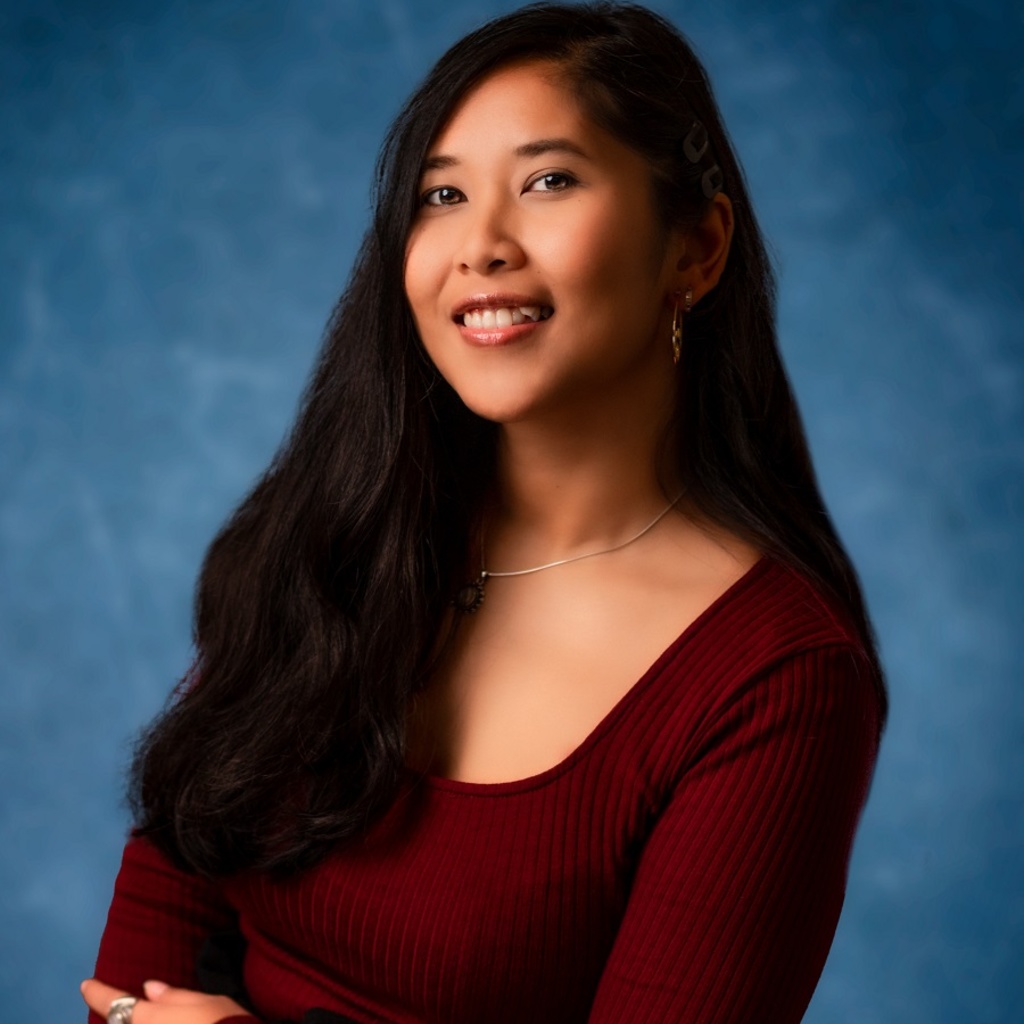
Headshot of woman in maroon shirt with long hair and arms crossed.

Bethanny Sudibyo Wins 2021 Humanities 3MT

Bethanny Sudibyo (Spanish & Portuguese, CLAS) won the 2021 Obermann Humanities 3MT for her presentation “Imperial Imaginings: Representations of Religion, Race, and Gender in 19th-Century Spanish Philippine Novels.” Sudibyo's win earned her a place in the campus-wide 3MT finals, the winner of which will be announced on November 12.
Ana Merino, Corey Creekmur, and Rachel Williams

University of Iowa Awarded 2022-23 Mellon Sawyer Seminar

The University of Iowa Obermann Center for Advanced Studies in the Office of the Vice President for Research is pleased to announce the award of a grant totaling $225,000 from The Andrew W. Mellon Foundation to host a Mellon Sawyer Seminar on “Racial Reckoning and Social Justice Through Comics” at the University across the academic year 2022-23.

Recent Events

The Writing-Enriched Curriculum: A discussion with Pamela Flash promotional image

The Writing-Enriched Curriculum: A discussion with Pamela Flash

Thursday, April 1, 2021 2:30pm
Virtual

In this discussion, Pamela Flash (University of Minnesota) will introduce the Writing-Enriched Curriculum (WEC) model and will think with local stakeholders about affordances and challenges associated with its potential implementation at the University of Iowa. WEC offers a departmental model designed to (1) support the curricular integration of relevant modes of writing and writing instruction and (2) to increase the rate at which student writing meets locally-generated faculty expectations...

Performing Latina/o/x Futurity (Sawyer Seminar Closing Conference) promotional image

Performing Latina/o/x Futurity (Sawyer Seminar Closing Conference)

Friday, March 26 10:00am to Saturday, March 27, 2021 3:00pm
Virtual

When COVID-19 interrupted the late spring events and culmination of the yearlong Mellon Sawyer Seminar Imagining Latinidades: Articulations of National Belonging, we didn't know that the events would eventually end up online and across institutions. In 2019-20, seminar co-directors Darrel Wanzer-Serrano, Ariana Ruiz, and Rene Rocha worked across disciplines to organize six symposia, a film series, and a podcast. With Wanzer-Serrano now in the Communications Department at the University of Texas...

STEM and Race: Can We Talk? promotional image

STEM and Race: Can We Talk?

Saturday, March 20, 2021 1:00pm to 4:15pm
Virtual

Can We Talk?

"Can We Talk?" explores the issue of ‘social belonging’ in the context of STEM (Science, Technology, Engineering, Math) and the effect it has on the lives of underrepresented people of color (UR-POC) who are pursuing an education or career in STEM, or who have decided to leave because of an overwhelming feeling of not belonging. The film has screened at venues across the U.S., at scientific conferences, colleges and universities, federal agencies, and for non-profit organizations. In...

Native Lands: Belonging and Reclaiming — An Obermann Conversation promotional image

Native Lands: Belonging and Reclaiming — An Obermann Conversation

Wednesday, March 10, 2021 7:00pm to 8:00pm
Virtual

Shelley Buffalo and Carrie Schuettpelz share their experiences as indigenous women who have thought hard about issues of belonging. Together, they'll consider what it means to belong to a Native American tribe, in terms of relationship to the land, the notorious blood quantum system for "measuring" someone's right to membership, and Indian cards. As people who have traveled far from home, living across the U.S. and abroad, they'll wonder together about how far and how long one can wander from...

Info Session: Humanities for the Public Good Graduate Research Assistant Position

Tuesday, March 9, 2021 1:30pm to 2:30pm
Virtual

Interested in the larger ecosystem of the humanities, diverse careers, and learning the skills necessary to be a successful project director and scholar? Apply to join the Humanities for the Public Good team as our 2021-2022 Graduate Research Assistant. Learn more about the role and meet our team at this March 9th 1:30 pm CT info session.

The Obermann Center seeks a graduate student to support the Andrew W. Mellon Foundation grant, Humanities for the Public Good (HPG), under the supervision...

Podcasting with Purpose: James Boo promotional image

Podcasting with Purpose: James Boo

Thursday, March 4, 2021 4:00pm to 5:00pm
Virtual

Calling all podcasters, podcast enthusiasts, and podcast newbies! Learn from expert podcasters about the craft of podcasting with purpose, from the nuts and bolts of recording and editing audio to the intellectual and creative labor of audio storytelling. As part of our goal to prepare graduate students for a wide range of careers serving the public good, Humanities for the Public Good is exploring new and innovative methods of interpretation, storytelling, and meaning-making. The Podcasting...