Upcoming Events

Cultivating Rurality: Building Community around Rural Research — 2025–26 Obermann Symposium promotional image

Cultivating Rurality: Building Community around Rural Research — 2025–26 Obermann Symposium

Friday, March 27, 2026 (all day)
Iowa City Public Library

Directed by Brian R. Farrell, Daria Fisher Page, and Ryan T. Sakoda (UI College of Law), "Cultivating Rurality: Building Community around Rural Research" will bring together scholars, community leaders from across the U.S., and professionals who work with rural populations and in rural spaces. During the symposium, attendees will be invited to collaborate in theorizing rurality, share how it impacts their work, examine how rurality is represented and celebrated, and begin to discuss challenges...
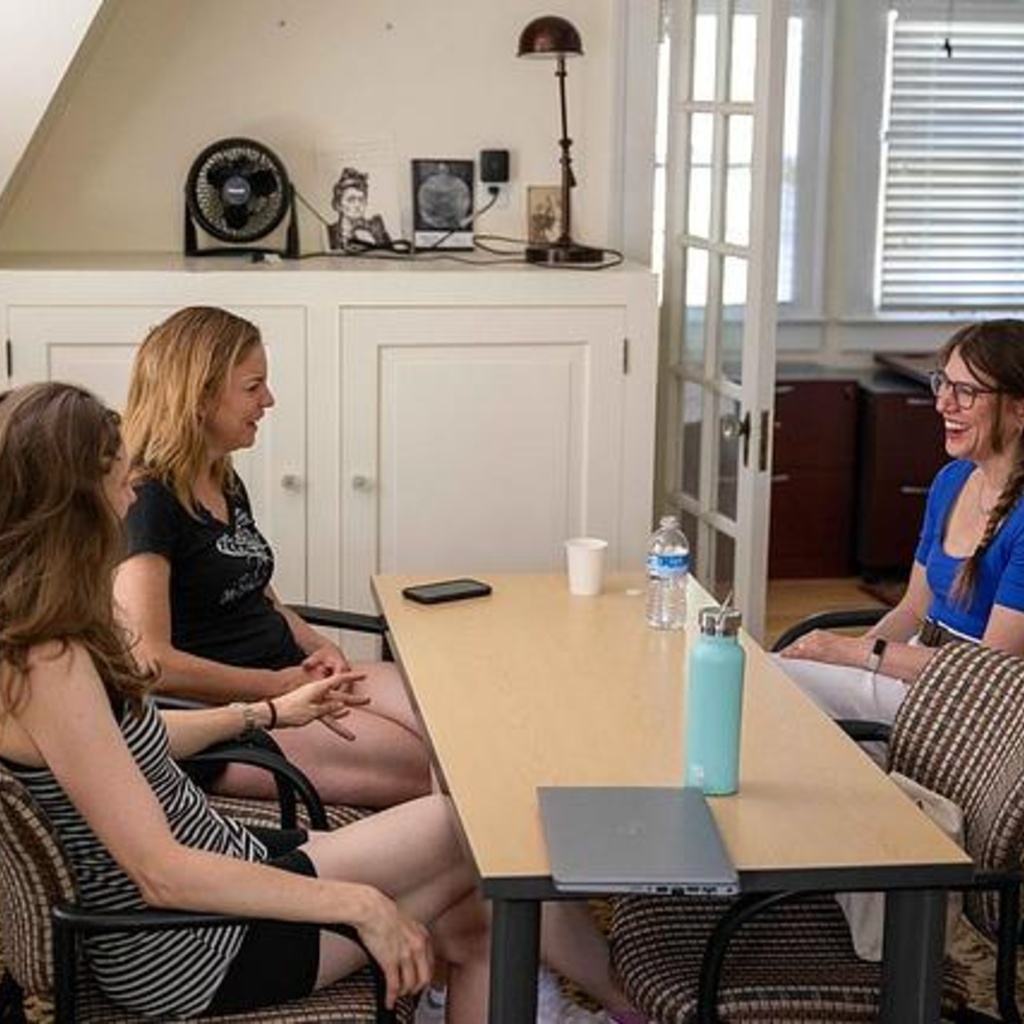
Humanities Write-In promotional image

Humanities Write-In

Thursday, April 9, 2026 2:00pm to 4:00pm
111 Church Street

The Graduate College has joined the Graduate Student Senate and the Graduate & Professional Student Government to encourage a week-long celebration of our graduate students from April 6-10, 2026.

Celebrate Graduate Student Appreciation Week with dedicated writing time and meaningful community. Join us for a focused Humanities Write-In facilitated by Grad Ambassadors, designed to offer structure, accountability, and connection for Iowa’s graduate and professional students working on any kind of...

Targeting the Psychological Roots, Not Branches, of Vaccine Confidence promotional image

Targeting the Psychological Roots, Not Branches, of Vaccine Confidence

Friday, April 10, 2026 3:00pm to 3:45pm
Biology Building East
Aaron Scherer examines the psychological roots of vaccine confidence and how to communicate more effectively about science.
The DTP Vaccine and Narratives of Injury promotional image

The DTP Vaccine and Narratives of Injury

Friday, April 10, 2026 3:45pm to 4:30pm
Biology Building East
Tara Smith explores the history of the DTP vaccine and the narratives that shape public perception of vaccine injury.
View more events

Spacer

Upcoming Application Deadlines

Upcoming Application Deadlines

Application Deadline: Small Important Project Grants promotional image

Application Deadline: Small Important Project Grants

Friday, May 8, 2026 5:00pm
111 Church Street

This new Obermann Center program offers modest yet swift support for those portions of research and creative endeavors by UI scholars that are important toward advancing a project but do not have enough funding from other sources. We will grant ten awards of $500 or less per academic year. Note that funds need to be spent by June 30 of each year.

Eligibility: Open to all University of Iowa faculty and staff researchers

Graduate students: Note that the Graduate College offers Small Grants for the...

News

Katy Schroeder and black horse

Allies in Healing: Katy Schroeder and the Human-Animal Interactions for Wellbeing Collaborative

The first time Katy Schroeder truly understood the positive impact of connecting people with animals in therapy, she wasn’t sitting in a lab or behind a desk. She was standing beside a horse. “I realized how passionate I was about integrating human-horse interactions into mental health treatment,” she recalls. “It was such a powerful realization.” At the time, Schroeder was living in Bend, Oregon, and pursuing her master’s degree in clinical mental health counseling. The idea of incorporating animals into therapy wasn’t new — but it also wasn’t widely studied or regulated. Still, something about it clicked. It lit a path she hadn’t seen before. “I caught the research bug,” she says. Encouraged by a mentor, Schroeder stayed on to earn her doctorate at Oregon State University, where she discovered her second calling: teaching. “That’s really when everything started to come together for me.” That clarity eventually led her to the University of Iowa, where she now serves as an associate professor in the College of Education's Clinical Mental Health Counseling Program in the Department of Counselor Education. There, she’s quietly reshaping how students — and the field—understand the relationship between humans and animals in mental health care.
Patricia in with a Hawkeye shirt

From the Hank Lab to the Streets of Romania: A Conversation with Patricia Marga

In a nation confronting one of the highest rates of traffic accidents in Europe, the simple act of crossing the street is a critical public health challenge. This issue is the driving force behind the work of Patricia Marga, a PhD student in public health from Romania. She's on a mission to tackle this crisis by exploring how virtual reality can be harnessed to study and improve pedestrian safety for the most vulnerable: elderly citizens crossing busy city streets and children navigating crowded school zones. Her pursuit of research methods on injury prevention brought her to the University of Iowa this fall as an Obermann International Fellow.
Jordan teaching

A Language in Motion: Jordan Gigout and Dance Notation

How do you write down a dance? To capture the body’s expressions, scholars have long turned to Kinetography Laban, a system for recording and analyzing movement that uses abstract symbols to define the direction of movement and the parts of the body that perform it, among other parameters. But what happens when that language of symbols is itself a historical artifact, reflecting the biases of its time? Can a system built on a specific vision of the body ever truly capture the full diversity of human movement, or does it inevitably shape what it records? This is the critical and creative realm of Jordan Gigout, a dancer and dance-notation scholar from Essen, Germany. His research explores how this historical language for movement can continue to evolve and inspire new ways of thinking about choreography today. This fall, we welcomed him as an Obermann International Fellow.
Shazia Khan

Time, Care, & the Moral Self with Shazia Rehman Khan

Often, an hourly employee, bound by the routines and schedules of a workplace, finds that she is constantly thinking about being somewhere she is needed more, perhaps at home, taking care of a child or elderly relative. While many researchers have studied how this internal conflict affects the worker's professional output, few have studied how it affects her self-image or moral self-concept. This is the province of Shazia Rehman Khan, Professor of Business and Social Ethics at Pakistan's Bahria University. Her scholarship asks whether women are the primary victims of organizational time structures (as they must often balance workplace schedules with demands for care and domestic work) and, more generally, how "clock time" shapes our moral selves. Khan recently spent a month at the University of Iowa as an Obermann International Fellow furthering her research on time justice and care ethics.
Sara Jo Cohen

Inside Scholarly Publishing: A Conversation with Sara Jo Cohen

Ahead of her November residency, we asked Obermann Editor-in-Residence Sara Jo Cohen about what she hopes to accomplish during her time here, her advice on crafting strong proposals, the challenges and opportunities of open access publishing, and the exciting ways digital platforms are expanding scholarship. She also shared her own career journey from graduate study in English to university press publishing, reflected on the skills early-career scholars most need to cultivate today, and offered practical guidance for undergraduates seeking a foothold in the publishing world.
Bern-Klug wearing American Association of Social Work and Social Welfare medal

Rethinking Aging with Mercedes Bern-Klug

How often do you spend time with people significantly older than you? Not very often, if you’re like most Americans. “We live in an age-segregated society,” notes Mercedes Bern-Klug, professor, mentor, researcher, and practitioner at the UI School of Social Work. “Young people hang out with young people. Teenagers hang out with teenagers. There are few opportunities for the generations to mix, outside of places of worship.” Plus, she says, contemporary American society tends to view life after 30 as, well…boring. As a result, many young people miss out on intergenerational interaction and its many benefits: reduced loneliness, improved mental and physical health—and, particular to adolescents, identity formation, skill development, and academic improvement. They also tend to miss out on career opportunities working with the ever-growing senior demographic. (Americans 65 and older are projected to make up 23% of the U.S. population within the next 30 years.) “Almost every health field is struggling to recruit enough students who want to work with older adults,” says Bern-Klug. To partly address this problem, the School of Social Work has created two general education courses aimed at freshmen—“Aging Matters: Intro to Gerontology” and “Mental Health Across the Lifespan”—with the hope of reaching more students.

Recent Events

Digital Bridges Symposium - FREE AND OPEN TO THE PUBLIC promotional image

Digital Bridges Symposium - FREE AND OPEN TO THE PUBLIC

Wednesday, August 8 to Friday, August 10, 2018 (all day)
MERGE

FREE AND OPEN TO THE PUBLIC

With generous support from our institutions and The Andrew W. Mellon Foundation, the Digital Bridges for Humanistic Inquiry: A Grinnell College/University of Iowa Partnership has been a fascinating, rewarding, and instructive experience in collaboration, digital pedagogy, and digital humanities practice. Our August 8-10 Digital Bridges Symposium will bring together faculty, staff, and students from both institutions and digital scholars from across the country as we...

Latina/o/x Studies Today — An Obermann Conversation promotional image

Latina/o/x Studies Today — An Obermann Conversation

Friday, July 20, 2018 3:00pm to 4:00pm
MERGE

Theorists Vargas, Mirabal, and La Fountain-Stokes (2017) describe Latina/o/x Studies as “an amalgamation of multiple disciplines, theories, and methods” that “has generated an expansive, innovative, and ever-evolving framework to understand the experiences of persons of Latin American and Caribbean descent in the United States as well as broader sociohistorical, political, and cultural processes.” The speakers below, all of whom are in town participating in the weeklong Iowa Workshop in Latina/o...

Misfitting: Disability Broadly Considered—2019 Obermann Humanities Symposium promotional image

Misfitting: Disability Broadly Considered—2019 Obermann Humanities Symposium

Wednesday, April 4, 2018 to Saturday, April 6, 2019 (all day)

Disability is a universal human experience. Like gender, race, class, and sexuality, disability affects everyone in multiple ways, shaping and informing our notions of normality, family, community, fitness, and worth. Disability Studies, one of the fastest growing interdisciplinary fields in the humanities, social sciences and health sciences, examines abilities in the context of societies and cultures as they change over time. The symposium will consider the pervasive (though often unnoticed)...

Publicizing Events: An Obermann Get It Done! Workshop promotional image

Publicizing Events: An Obermann Get It Done! Workshop

Tuesday, October 3, 2017 12:00pm to 1:00pm
111 Church Street

Get It Done is a new BYO Brown Bag Lunch series about getting work done efficiently and with style. Bring your lunch and join the fun!

Are you bringing a visiting lecturer to campus year, planning a symposium, or organizing an exhibit? Whether your event is one-hour long or three days, you are probably hoping for an audience. Jennifer New, who heads up Obermann's communications team, will share strategies for publicizing events on campus and in the community. Learn about publicity calendars...