Spacer
Upcoming Application Deadlines
Upcoming Application Deadlines


News

Frequências symposium a historical gathering of Brazilian filmmakers and scholars on the UI campus
Taking Brazil’s new Black cinema as its point of departure, Frequências: Contemporary Afro-Brazilian Cinema & the Black Diaspora brings together filmmakers, artists, scholars, and critics from across the globe to explore new ways of thinking about the Black diaspora.
This 2022-23 Obermann Humanities Symposium and International Programs Major Projects Award takes place March 30 – April 1, 2023, in Iowa City. Organized by Christopher Harris, F. Wendell Miller associate professor of cinematic arts at the University of Iowa; Janaína Oliveira, curator and researcher at the Federal Instituto of Rio de Janeiro; and Cristiane Lira, supervisor of Portuguese at the University of Georgia, the symposium will feature the emerging wave of young Afro-Brazilian filmmakers, curators, programmers, and scholars whose art and scholarship have already had an impact on international cinema.
Working to Create Nets: A Humanities for the Public Good Update
Back when we all traveled regularly to conferences, we did so to share research, to learn from colleagues, and to form new relationships, even friendships, rooted in shared intellectual interests. Conferences help graduate students build skills—capturing complex arguments in short presentations, public speaking, asking helpful rather than grandstanding questions, connecting with fellow experts, and more. In other words, conferences are for networking.

Meet Willie Zheng, our Undergraduate Communications Assistant
This year, we're thrilled to be working with undergraduate communications assistant Willie Zheng. A pharmacy major, Willie is a freshman from Marion, Iowa. His work at Obermann ranges from calendaring to social media strategizing. We're so glad to have found him!
What inspired you to choose pharmacy as both your major and career path?
WZ: I think the foundational inspiration that led me to decide pharmacy as my major was COVID. I was really inspired by the way our medical researchers and our pharmacists became a critical step in getting the pandemic under control, getting our kids, including myself, back in school, and getting people back to work. In addition, throughout my life, I have always wanted to have a career within the healthcare industry, as well as working and serving local communities like my hometown. Pharmacy is a great example of a healthcare career that serves communities across the nation in providing life-saving medications for all.

The City We Make Together — New book explores civic engagement
You walk into a space for a performance—not a theater, per se, but a gym or a ballroom—and find two rows of chairs with an aisle down the middle. Up front, a long table is set with name tags, microphones, and a folder in front of each space. Cameras are trained on the table, and large monitors on either side of the room broadcast what they capture along with captions. A microphone is positioned toward the front of what could be called the audience side of the room, while an American flag is posted behind the table.
This is the set of City Council Meeting, a performance that occurred in five U.S. cities (Houston, San Francisco, New York City, Keene, and Tempe) in the mid-aughts. It is the focus of a new book, The City We Make Together: City Council Meeting’s Primer for Participation in the Humanities and Public Life series, a collaboration between the Obermann Center and the University of Iowa Press. Written by two of the core theater makers behind the piece, Mallory Catlett and Aaron Landsman, the book also serves as a prelude and additional tool for a curriculum that is being created as an extension of the production.

Redesigning Introductory Graduate Courses
During the past several years, nearly a hundred faculty, staff, and graduate students have been part of the transformational work of the Mellon Foundation-funded Humanities for the Public Good (HPG). Together, we developed an appreciation for the value of incremental changes. Through a series of HPG course mini-grants, we invited faculty to find discipline-appropriate ways to integrate HPG values and practices, asking each awardee: How can we prepare students to use humanistic methods and mindsets and a commitment to social justice to position themselves for success in diverse careers?” Many faculty members who took advantage of the mini-grants were rethinking introduction to graduate studies courses in their departments.

New National Translation Center Builds on UI's Strengths and Extends Reach
Two Obermann Center–affiliated scholars have been awarded one of the largest amounts ever granted to a humanities project at the University of Iowa. Aron Aji, director of the MFA in Literary Translation, and Pam Wesely, an associate dean in the College of Education and professor of multilingual education, are the PIs for a Department of Education grant that totals more than $1 million. Aji co-directs the Obermann Working Group Translation across the Humanities and Wesely was a 2018 Fellow-in-Residence.
The four-year grant will allow the UI to launch a new National Resource Center (NRC) to advance translation and global literacy skills for K-16 students and educators, graduate students, and established scholars. It joins an elite group of NRCs at universities across the country and becomes the only one focused on translation. NRCs are language and area or international studies centers that serve as national resources for teaching any modern foreign language.
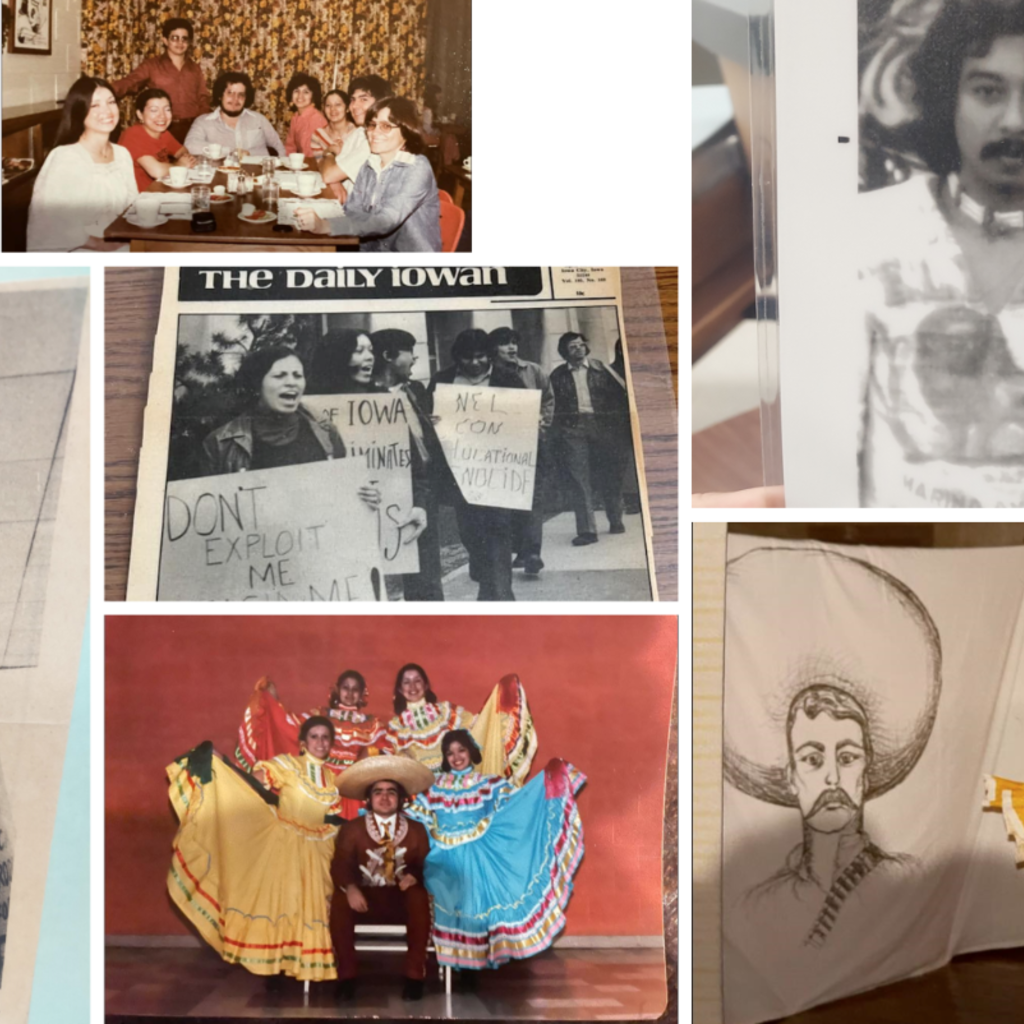
Recent Immigrant and PhD Student Thrives on Stories of UI's Latinx History
For Maria Leonor Márquez Ponce, a Humanities for the Public Good internship at the University of Iowa Libraries’ Special Collections and Archives is more than a summer gig—it’s also a way to connect with her own past and to find inspiration for her future. “Sometimes looking back at history can surprise you. You learn so much and you are inspired by it,” Márquez Ponce shared. Considering that she never believed that a college degree would be attainable for her, much less a PhD, she has found a deep connection to this project and the people whose stories she is sharing.

Imagining Latinidades Convenes Writing Retreat
This June, the Imagining Latinidades Mellon Sawyer Seminar gathered 10 faculty and graduate students in Latina/x/o studies at the Obermann Center. Participants from across the UI and local colleges came together to write and work in community and to craft dynamic lesson plans to share on the Imagining Latinidades website.
"Summertime often shows up as a moment for getting lots of writing and research done and, at the same time, for rest and replenishment," says co-organizer Naomi Greyser (American Studies, GWSS, English, UI). While those aims can feel contradictory at times, this retreat was filled with reflective immersion, stimulating workshops, time spent outdoors, shared meals, and much laughter.

Seeking Memories in Poland: MFA playwright reckons with Holocaust memorialization
As part of its support for the Anne Frank Tree Planting Ceremony, the Obermann Center provided funding to Emma Silverman, an MFA candidate in the UI Playwrights Workshop, toward completion of Silverman's thesis play. Emma performed an excerpt from Stars and Stones at the Tree Planting Ceremony last Friday. The play will be staged in its entirety this Thursday, May 5, 2022, as part of the UI's New Play Festival. (See ticketing details at the end of this article.)
Silverman is the recipient of a Marcus Bach Fellowship, an award given by the UI College of Liberal Arts and Sciences, to support the completion of an MFA project or doctoral dissertation, particularly work that fosters intercultural communication and/or the understanding of diverse philosophies and religious perspectives. Silverman intended to use the award toward direct research of Holocaust tourism.

Scholar, Descendant, Collaborator: Jodi Skipper's new book explores slave dwelling project
The words "slavery" and "tourism" don’t seem like they belong anywhere near each other. But a growing number of Americans of all races are eager to better understand our country’s complicated history by visiting places where difficult and often darkly violent events occurred. Ensuring that we, the touring populace, receive complete stories when we arrive at these spaces, a network of historians, anthropologists, and community activists are working against time to save the material remnants of the lived experience of enslaved people.
Among them is Jodi Skipper, a University of Mississippi professor of anthropology and southern studies. For the past decade, she has used tools as an archaeologist, scholar, teacher, and community member to widen and deepen the shared narratives of historic sites in the U.S. south. She has shared these experiences in a new book, Behind the Big House: Reconciling Slavery, Race, and Heritage in the U.S. South, just published by the University of Iowa Press.