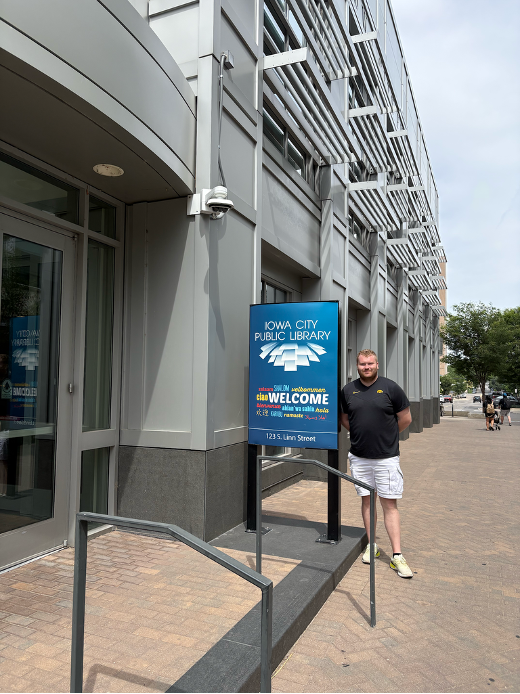
This summer I've had the privilege of working with the Development Director of the Iowa City Public Library Friends Foundation (ICPLFF), Katie Roche. As a Government Affairs and Advocacy Intern, I've relished the opportunity the Obermann Center granted to expand my professional horizons beyond academia and to translate that experience directly into future industry opportunities. I see advocacy work mirroring the same kind of work consultants do in strategic advising. Though I worked for the ICPLFF, I felt as though I were a consultant for the Iowa Library Association (ILA), performing similar tasks. The phased approach proposed by my site mentor, Katie Roche, and ILA's Amanda Sand paved the way for me to transfer academic skills into actionable advocacy materials for libraries. To assist the functions of the Government Affairs Committee, I prepared the analysis, frameworks, and recommendations that will be delivered to ILA leadership before the 2027 legislative session.
Like a consultant's, my deliverables come from deep research and groundwork mapping the current state of library advocacy. First, I was tasked with defining the landscape and scope in a reference guide, curating pro-library statistics, explaining funding's complexities, and mapping Iowa's politicized state legislature into a single document meant to guide sustainable, year-round advocacy. Working from tools ILA already has, the bill tracker and the 2026 Legislative Agenda and Comprehensive Policy Platform, I built a concise policy and legislative landscape report for ILA leadership and members that serves both ILA and Iowa citizens.
Next, I performed competitive benchmarking, where I realized comparative analysis of peer states and states that shape national political discourse. There, I discovered gaps in Iowa's advocacy and a strategy for closing them. Capability-building demanded that I perform both quantitative and qualitative analysis. The Government Affairs Committee's LibGuide is already robust, but my comparative analysis memo outlining best practices and recommended adaptations for ILA aims to activate more outreach and participation from engaged citizens. There is a clear opportunity for converting patrons into advocates and activating those who've forgotten what libraries offer. For example, access to computers is an efficient way for municipalities to promote social mobility. Also, libraries provide a space to combat the literacy crisis and grant access to information for everyone. Parents and children look to the library as a space for learning outside of the classroom and to seek entertainment outside of screens. One interesting fact I learned during the summer is that studies show that for every visit to the public library, it is nearly guaranteed that patrons will then spend their money at other nearby businesses, augmenting the economic benefit of library investment for everyone.
Drawing from the work of Iowa's own Sam Helmick, I concur that storytelling can be a key tool for securing libraries' future. Encouraging the public to share their personal experiences that highlight the benefits they’ve received from libraries naturally avoids ideologically charged language. Outreach templates for writing to legislators and social media guidance complement what ILA already executes, though my own assessment is that these measures deserve more prominence.
On July 16, 2026, the American Library Association's Council adopted its "Guidance on the Use of Artificial Intelligence in Libraries." Libraries nationwide can deliver the public benefit of American technological advancement. For example, we can implement more dynamic advocacy tools (https://www.quorum.us/), and adjacently promote citizens’ free access to the newest technological capabilities that extend the workspaces libraries already provide. A 2022 survey of academic and public librarians found that only 21 percent were currently using AI or related technologies, while 80 percent expected them to be standard within libraries within 30 years, and 68 percent wanted training now (Yoon, Andrews, and Ward, Library Hi Tech, 2022). The same study cites Becker and colleagues' expectation that these tools will "amplify the utility and reach of library services." ALA's own guidance permits choosing not to license or provide a particular piece of software as a legitimate professional call, not a failure to modernize, and it recognizes that patron prompts and searches already function as unpaid input into systems patrons hold no stake in. Libraries are among the few civic institutions positioned to make sure adoption doesn't just extract from the people they serve. If governments and AI corporations are taking so much from the American people, public libraries could be the avenue through which citizens capture real productivity from these tools, entrenching themselves as AI educational hubs. A “library-first” agenda that places these cherished spaces at the forefront of technological evolution is the framework for that equitable future, holding authority over how public resources are deployed and consumed.
Public libraries are, in my view, a deeply American institution. Statesmen like Benjamin Franklin and titans of industry like Andrew Carnegie enshrined the idea that free access to information ought to be a pillar of our republic. I have specific childhood memories of visiting the Lower Macungie Library in Pennsylvania, where my mother took my sister and me almost daily each summer to pick out books and movies. Those same memories ought to be guaranteed to every American. I hope this summer's consulting and pursuit work proves effective for Iowa's library patrons, and for translating humanities scholarship into a possible career in industry.
Sources:
- American Library Association. Guidance on the Use of Artificial Intelligence in Libraries. American Library Association, June 2026, www.ala.org/sites/default/files/2026-06/ALA%20CD%2044.2%20AI%20Guidance%20Document%20-%20Final.pdf.
- Yoon, JungWon, et al. "Perceptions on Adopting Artificial Intelligence and Related Technologies in Libraries: Public and Academic Librarians in North America." Library Hi Tech, vol. 40, no. 6, 2022, pp. 1893-1915, doi.org/10.1108/LHT-07-2021-0229.
Gregg Johnson is a PhD student in the Department of Spanish and Portuguese at the University of Iowa.